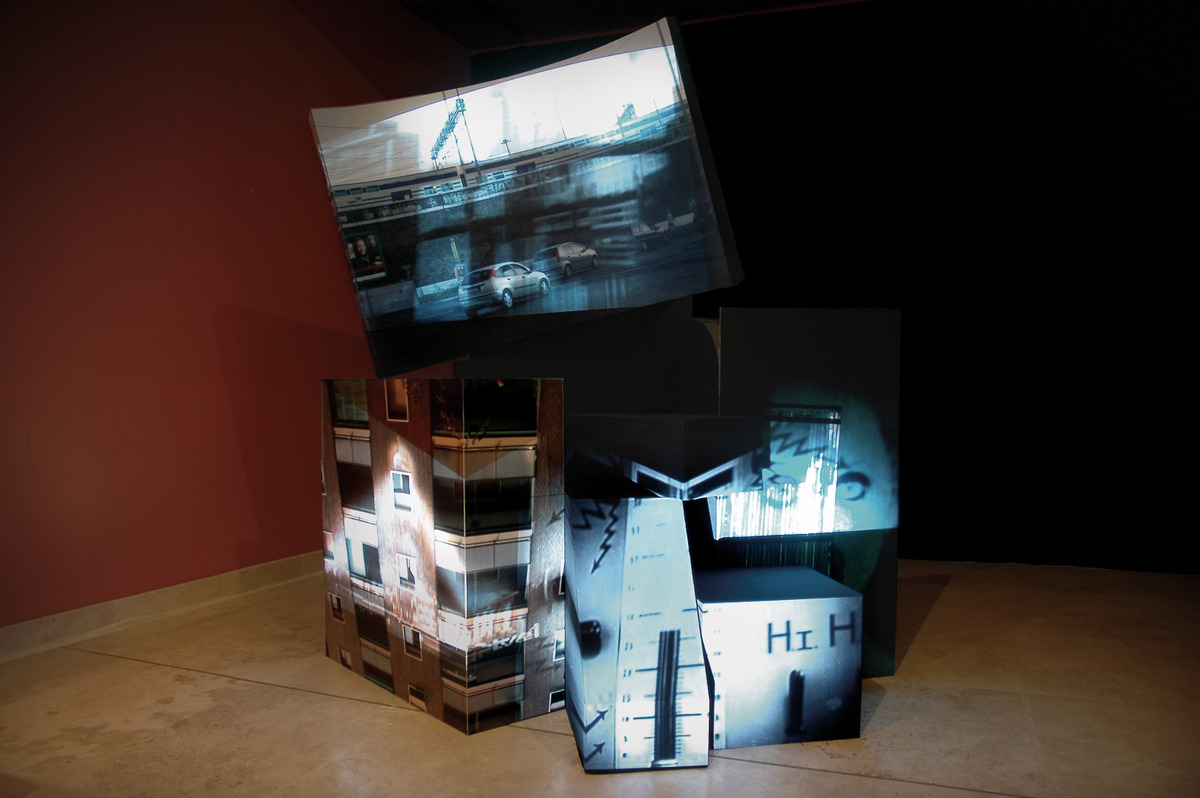

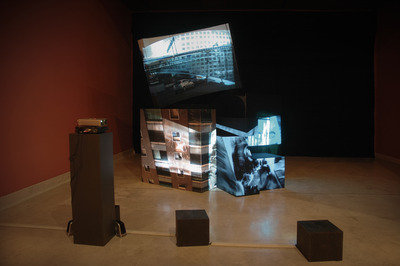
MATERIALS: Photographic prints on PVC, wood, fabric, 3 digital projectors with wooden cover, audio speakers
PROJECTION: Fritz Lang, Metropolis , 1927
Digital, three channels, black and white, sound, loop
MUSIC: Ennio Colaci
DIMENSIONS: 288 × 253 × 195 cm
SOUND: Ennio Colaci
INSCRIPTIONS: Titled, dated and signed on the verso of the sculpture:
‘“Women of Italy – Fritz Lang” 2009 / Fabio Mauri’
PROVENANCE: The artist
COLLECTION: Fabio Mauri Estate, Rome
CATALOGUE: PR_2009_637
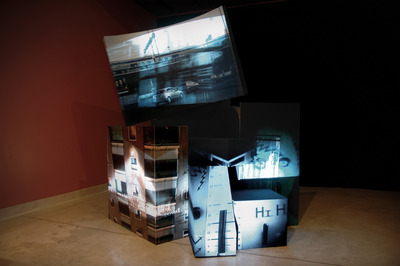
A sculpture composed of eight wooden volumes covered in photographs and black fabric, juxtaposed and stacked to form a plastic unicum on which three different clips from Fritz Lang’s film Metropolis are projected. The photographic images offer up glimpses of the Roman suburbs; the projections linger on the figure of Mary, an android created in her image and likeness, and an urban environment characterized by skyscrapers and elevated streets. The work was created in 2009 for an exhibition at the Auditorium Parco della Musica in Rome at which fifty-eight artists, in dialogue with fifty-eight writers, exhibited works and pieces on the theme of women in relation to the city. Paired up with writer Mariolina Venezia, Fabio Mauri narrated the dystopian environment of urban suburbia. Mauri reprised apocalyptic evocations previously investigated at the ‘Inverosimile’ exhibition (inv. 986)1 in Venice, offering a text from his novel Altri miracoli.2 The originally silent film was accompanied by electronic music from Ennio Colaci.
1. The wooden elements that make up this sculpture came directly from the installation displayed at Hangar Bicocca in Milan, assembled anew.
2. M. Venezia, Altri miracoli, Einaudi, Turin 2009. In the exhibition catalogue, an excerpt read: ‘A city. Buildings, rows of horizontal and vertical windows. Streets, piazzas, alleyways and courtyards. A kiosk stands at the corner. Bridges, railways, overpasses. In some places, the asphalt had potholes. Some windows, actually, most of them, had anodised metal frames because they were cheaper and prevented drafts. In some neighbourhoods, there were little gardens where children played. Buses passed by. Parked cars here and there. Red, green and flashing traffic lights. Trams too. Sidewalks with dog poop on them. Shop windows being dressed. People leaving their homes. Going to offices, supermarkets, picking up their kids from school. They go home. Sometimes, a partition allows sounds to leak from one apartment to another – the radio, a fragment of conversation. Face-to-face in the subway, some people look at one another trying to guess, but once they reach their stop, they forget.’
2009, Rome, Auditorium Parco della Musica, Donne di Roma, 28 January – 8 March.
2012, Milan, Palazzo Reale, Fabio Mauri – The End, 19 June – 23 September, curated by Francesca Alfano Miglietti.
Donne di Roma, exhibition catalogue, Auditorium Parco della Musica, Rome, edited by Giuseppe Cerasa (Rome: Nero, 2009), p. 103 (ill.).
Carlo Alberto Bucci, “Donne di Roma”, in la Repubblica, Rome, 28 January 2009, p. XV.
Carlo Alberto Bucci, “Donne di Roma. Vernissage con artisti e scrittori”, in la Repubblica, Rome, 29 January 2009, p. 1 e XIII.
Fabio Mauri. The End, exhibition catalogue, Palazzo Reale, Milan, edited by Francesca Alfano Miglietti (Milan: Skira, 2012), pp. 132–133 (ill.).
Lea Mattarella, “La storia come tragedia”, in Arte, no. 467, Milan, July 2012, p. 83 (ill.).
Mauri, edited by Flaminio Gualdoni (Milan: Corriere della Sera, 2022), pp. 80–81 (ill.).