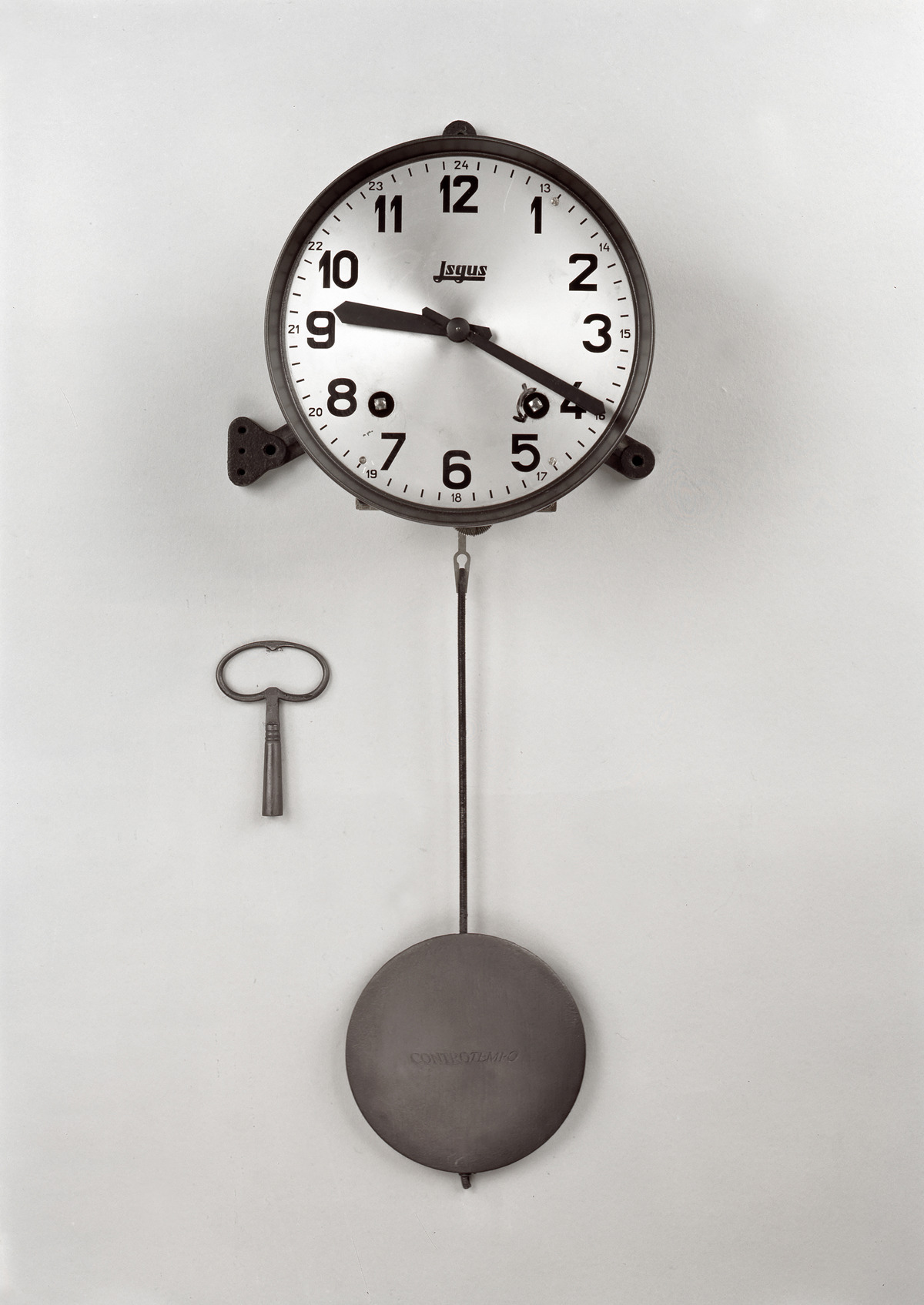
MATERIALS: Modified pendulum clock, micaceous enamel, graphite and metal engraving
DIMENSIONS: 62 × 25 × 16 cm
INSCRIPTIONS: Title engraved on the pendulum: ‘Controtempo ’
PROVENANCE: The artist
COLLECTION: Giorgio Teglio, Genoa
CATALOGUE: O_1996_529
The artist modified the mechanism of a 1940s time-card punch clock, reversing the direction of rotation from clockwise to counterclockwise. Hanging from the dial is a handcrafted pendulum consisting of a threaded bar and a graphite-coated metal disc, on which the title Contro tempo is engraved. ‘The work refers to an idea of time in which time is counted backwards: not as the sum of moments, but as their subtraction from a time indefinite in duration but hypothetically closed, the very same way physical space is. If this is true for one man’s life, it can be true for the duration of the world. This consideration introduces a metaphorical element relating to the idea of art-making as the employment of time in a sense, if equally cadenced, contrary to the progressive idea the world habitually makes use of. Past, present and future are reversed therein. The present occupies the same place, but future and past swap place and function. Something that, in art, is an everyday exercise.’1
1. F. Mauri in Fabio Mauri: Male e bellezza – Das Böse und das Schöne, catalogue of the exhibition (Kunsthalle, Klagenfurt, 1997), edited by A. Rohsmann, Klagenfurt, 1997, p. 117.
1997, Klagenfurt, Kunsthalle, Fabio Mauri. Male e bellezza / Das Böse und das Schöne, 24 April – 30 June, curated by Arnulf Rohsmann.
1997-1998, Milan, Studio Casoli, Fabio Mauri: Autobiografia come teoria, 12 November 1997 – 12 January 1998.
1998, Castelluccio di Pienza (Siena), Galleria La Tartaruga, Picnic o Il buon soldato, 5 September – 11 October, curated by Benedetta Origo, Plinio De Martiis.
1999, Barcelona, Fundació “La Caixa”, La meva cosina Marcella i la guerra civil, 29 January – 21 March, curated by Martí Peran.
2003, Venice, Galleria Nuova Icona, Fabio Mauri. Istantanea di un duca morto, 12 June – 31 October, curated by Vittorio Urbani.
2013, Venice, Galleria Michela Rizzo, Fabio Mauri. Picnic o il buon soldato, 23 September – 14 December.
2019, Herning, Heart Museum, Fabio Mauri: The End, 23 March – 25 August, curated by Michael Bank Christoffersen.
2026, Venice, Galleria Michela Rizzo, Fabio Mauri. L'Esperimento del tempo, 6 August – 29 August, curated by Ivan Barlafante.
Fabio Mauri: Male e bellezza – Das Böse und das Schöne, exhibition catalogue, Kunsthalle, Klagenfurt, edited by Arnulf Rohsmann (Klagenfurt, 1997), p. 117 (ill.).
Fabio Mauri. Picnic o il buon soldato, exhibition catalogue, Galleria La Tartaruga, Castelluccio di Pienza (Siena), edited by Plinio De Martiis (San Quirico d’Orcia, Siena: Editrice DonChisciotte, 1998), cover (ill.).
M. P., “Pic nic o il buon soldato”, in Il Bagattino, Montepulciano (Siena), 9 September 1998, p. 15.
Il luogo dei luoghi, exhibition catalogue, Istituto Geografico Italiano, Rome, edited by Gianni Bornia, Mario De Candia, Barbara Tosi (Rome: Società Geografica Italiana, 1999), pp. 28–29 (ill.).
Fabio Mauri, Scritti in mostra. L’avanguardia come zona 1958-2008, edited by Francesca Alfano Miglietti (Milan: il Saggiatore, 2008), pp. 106–108 (ill.).
Fabio Mauri, Io sono un ariano (Milan: Lampi di stampa, 2009), pp. 369–370 (ill.).
Alfabeta 2, Year I, no. 2, Milan, September 2010, p. 33 (ill.).
Federica Boràgina, Fabio Mauri. Che cosa è, se è, l’ideologia nell’arte (Catanzaro: Rubbettino editore, 2012), cover, p. 123, no. 30, p. 128 (ill.).
Heart Museum, Spring–Summer 2019, p. 57 (ill.).