MATERIALS: Installation of artworks
CATALOGUE: I_1990_3760
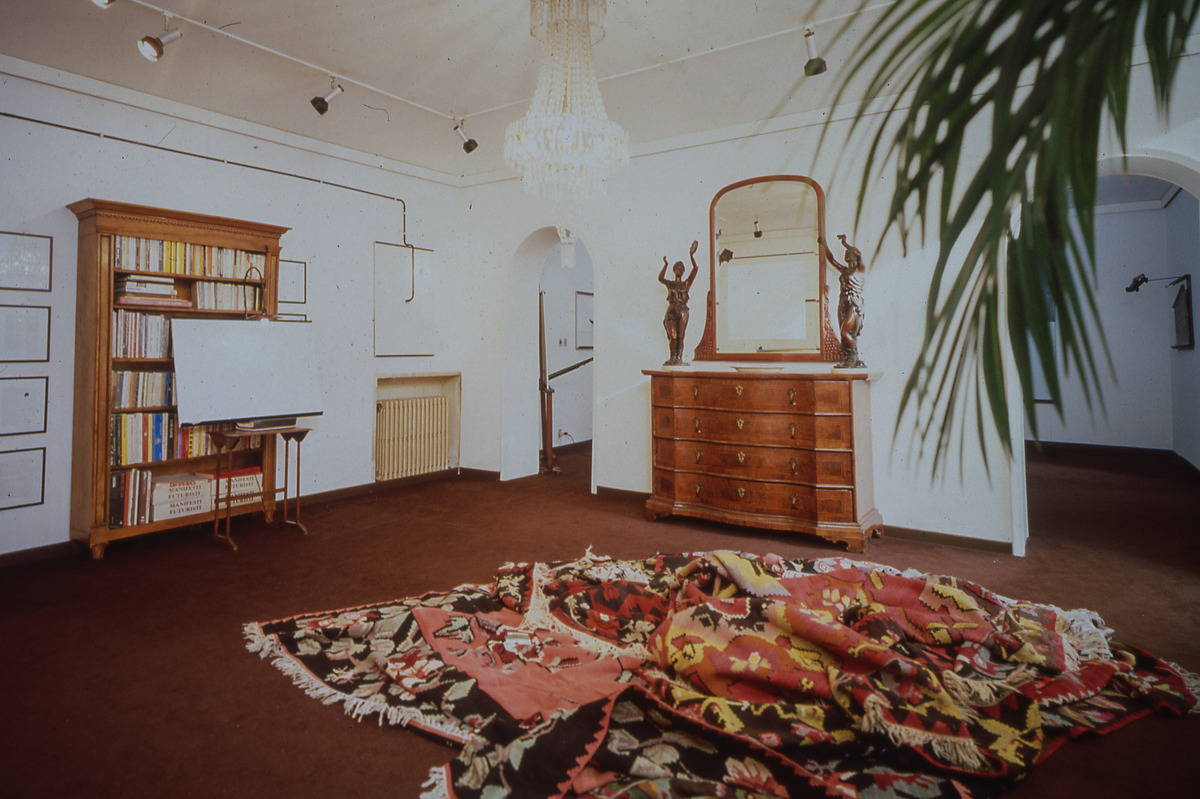
In 1990, Mauri presented his Interno installation in the ‘L’artista e lo spazio’ exhibition at the Anna D’Ascanio Gallery in Rome. With some variations, he also subsequently showed it at the Carini gallery in Florence, under the title Interno/Esterno (Indoor/Outdoor). The experience was like entering a private apartment: carpets, dressers, plants, an armchair, a bathtub, a kitchen and a bookcase – all from the artist’s home – arranged in the space, accompanied by monochrome paintings on board painted using a primer of Bologna chalk, rabbit-skin glue and the embossed, white-on-white inscription ‘SENZARTE’ (WITHOUT ART), enclosed by an iron frame but open along its short sides.1 A wide variety of objects entered and left these monochrome screens: fishing rods, paintings, chandeliers, rifles, tools, various artefacts that plastically intervened in the composition, establishing a dialogue with the surrounding space. ‘I capture not the representation but the thing itself with a minimal simulacrum of representation. My "paintings" or "houses" are networks. I fish out what I see and am surrounded by what engages or oppresses me.’2 Among the white painting silhouettes, here and there were citations from Van Gogh’s Bedroom in Arles (1888–89) (inv. 584): Mauri broke down and recomposed elements from the painting, exploring its mental architectures, introducing into his maison d’artiste a second-degree interior in close dialogue with the historical avant-garde. ‘Each exhibition is a personal case. A personal “home”. Here, a veritable move. From Piazza Madama to Via del Babuino to Via san Niccolò in Florence. Not only the “quality”, as ever, but the very “place” of the work presents on the border of a complex identification between the real and the imaginary.’3 As Mauri specified at the end of the catalogue, ‘Art is always close to its opposite. There it sits, a millimetre away from its opposite. This imperceptible boundary is the place of experimentation, of aesthetic criticism less constrained by its own general system of ideas, rendering the motive for agile and acute dispatch theoretically uncertain. The dividing line is an abyss: it is the place of form, of the birth of forms. Art is, in fact, always on the verge of not being art.’4
1. The paintings are enclosed in an iron frame shorn of its side uprights, the top and bottom edges leaning towards the inside of the painting, tilted at about 45°. Mauri wrote: ‘[The frames] are open to the sides. Two diagonal irons, one above and one below, form a roof. Two roofs. They are the roofs of infinite houses. Places of identity.’
2. F. Mauri, 'Autocolloquio', in F. Mauri, Scritti in mostra: L’avanguardia come zona 1958–2008, edited by F. Alfano Miglietti, il Saggiatore, Milan, 2008, pp. 79–83.
3. F. Mauri, 'Note', in Fabio Mauri. Interno / Esterno, catalogue of the exhibition (Rome, Galleria Anna D'Ascanio and Florence, Galleria Carini), edited by L. Masini, A. Boatto, Rome / Florence, 1990, p. 64.
4. F. Mauri, ‘Collage’, in ibid., p. 65.
1990, Rome, Galleria Anna D’Ascanio, Fabio Mauri: Interno, 9 March – 21 April.
1990, Florence, Galleria Carini, Fabio Mauri: Interno / Esterno, 19 May – July (travelling: 1990, Rome).