

PERFORMER: 50 fine-art students, a musical band. Guests: Tullio Crali (artist), Toti Scialoja (artist), Maurizio Calvesi (art historian and critic), Joan Logue (vocal concert artist), Carlo Stephanos (actor), Hilary Mostert and Brunella De Biase (dancers), Antonello Neri (musician)
PROJECTION: Bruno Corra, Emilio Settimelli (attr.), Curiosità (Curiosity) and Musica (Music) , 1920s
PROPS: Set and costumes inspired by Futurist artworks, live music
DURATION: About 4 hours
DOCUMENTATION: Photographs, script, video
RE-ENACTMENTS: Yes
COLLECTION: Fabio Mauri Estate, Rome
CATALOGUE: P_1980_3510
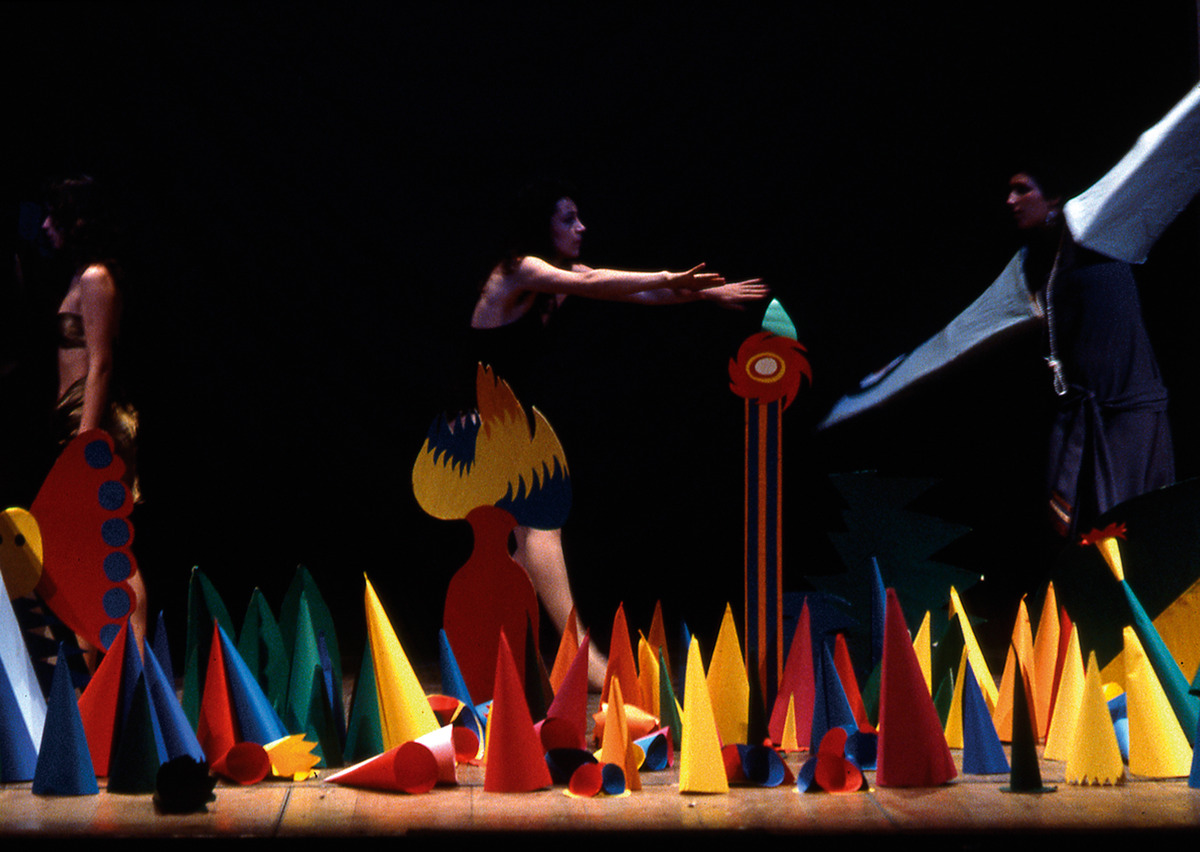
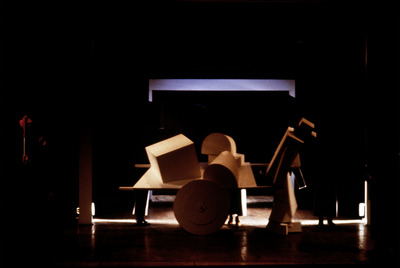
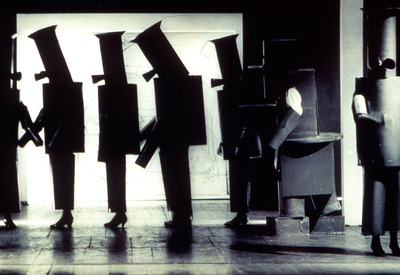
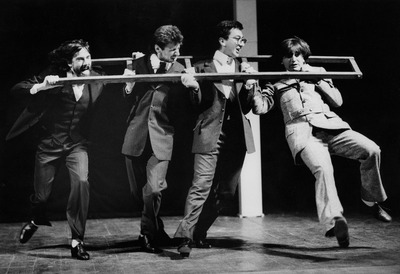
In 1979, Mauri, Professor of the Aesthetics of Experimentation at the Academy of Fine Arts in L’Aquila, involved students and faculty in what was to be the most complex show of his artistic career: ‘I turned my now almost old-fashioned idea of a global show on Futurism into a project, determined to challenge a certain historical oblivion that never ceased to amaze me, and render my perceptions concrete. I had a whole school at my disposal. The students’ and teachers’ ages were the same as the early Futurists’.’1 Mauri produced a ‘Gran Serata’ (Gala Evening), a collage of synthetic theatre, parolibera and pentagrammed poetry, dance and noise music spanning rigorous philological reconstruction and free interpretation. Performed on six occasions on three different tours (1980, 1982 and 1986) in various venues and cities, the play was staged in an ‘Italian-style’ theatre ‘in which Futurist text, parodying classical or chamber theatre, high and low, resounded to a double novelty effect’.2 The action began in the foyer, laid out with posters and reproductions of Futurist works, where the incoming audience was overwhelmed by performances by artists and dancers stationed at various points, and a village band in uniform played. Divided into three parts – Manifesto e Anteguerra (Manifesto and Prewar) (1909–14); Guerra (War) (1914–18); and Dopoguerra (Postwar) (1918–30) – the performance continued in the theatre hall. Poems and theatrical skits followed as if part of a parade, invading every space within the theatre, first among the audience in the stalls and galleries, then on stage, alternating monologues and choral scenes with Futurist-inspired sets and costumes accompanied by live music. The students – not actors but young artists ‘reliving a philologically reconstructed cultural role’3 – were joined in some performances by professionals and ‘well-known people’. Participants included Futurist Tullio Crali, who read Marinetti’s 700 chilometri all’ora; art historian Maurizio Calvesi who, from the audience, wore a mask of himself, representing the voice of criticism through loudspeakers in the hall; artist and friend of Mauri’s Toti Scialoja, who declaimed Aldo Palazzeschi’s poem Diana; vocal concert performer Joan Logue reading Francesco Cangiullo’s Poesia pentagrammata; and dancer Hilary Mostert performing to Marinetti’s words. For the music, Mauri entrusted a number of valuable rediscovered scores by Silvio Mix, Luigi Russolo, Franco Casavola and Francesco Balilla Pratella to Maestro Antonello Neri’s direction. The version performed in Venice featured cinema too, with a screening of two very rare short films that Mauri unearthed at the Istituto Luce, entitled Curiosità (Curiosity) and Musica (Music), attributed to Bruno Corra and Emilio Settimelli.4 The fast-paced, irreverent show lasted nearly four hours, featuring ‘parades’ of Futurist paintings, leafleting the audience, motorcycle forays and dog performances, ending with an evocative stage interpretation of Futurist artists’ Balla and Depero’s Futurist Reconstruction of the Universe manifesto, followed by its symbolic Distruzione, among the skyscrapers of Sant’Elia, all overlooked by Vera Idelson’s looming robot.
1. F. Mauri, ‘Gran Serata Futurista 1909–1930’, in Artisti &venti a L’Aquila 1944–1999, Angelus Novus Edizioni, L’Aquila, 1999, p. 113.
2. Ibid., p. 114.
3. F. Mauri, Interview, RAI – Radio Televisione Italiana, 1982.
4. See A. Madesani, Le icone fluttuanti, Bruno Mondadori, Milan, 2002, p. 41 and F. Mauri, Io sono un ariano, Lampi di stampa, Milan, 2009, p. 23.
1980, L’Aquila, Teatro Stabile, Gran Serata Futurista 1909-1930, 4 June.
1982, Rome, Teatro Olimpico, Gran Serata Futurista 1909-1930, 4–6 March.
1982, Milan, Teatro Nuovo, Gran Serata Futurista 1909-1930, 12–14 March.
1986, L’Aquila, Courtyard of the Palazzo San Domenico, Gran Serata Futurista 1909-1930, 18 June.
1986, Venice, Teatro Goldoni, Gran Serata Futurista 1909-1930, 3–6 June.
Laura Cherubini, “Gran serata futurista”, in Segno, no. 17, Pescara, September 1980, p. 39.
Fabio Mauri, “"Gran serata futurista 1909-1930"”, in Stilb, Year I, no. 2, Rome / Avezzano, March–April 1981, pp. 71–73 (ill.).
Giorgio Verzotti, “Ricostruzioni Sceniche. Il futurimo italiano e Oskar Schlemmer nell'ambito della sperimentazione teatrale”, in Flash Art, no. 108, Giancarlo Politi Editore, Milan, May 1982, p. 20 (ill.).
Gran Serata Futurista 1909-1930, edited by Fabio Mauri (Rome / Milan: Teatro Olimpico / Teatro Nuovo, theatre programme, 1982), .
Gran Serata Futurista 1909-1930, edited by Fabio Mauri (Venice: Teatro Goldoni, theatre programme, 1986), .
Fabio Mauri, “In terza persona”, in Art E tra, Year 1, no. 1, Centro multimediale "Quarto di Santa Giusta", edited by Enrico Sconci, L'Aquila, May 1989, cover, pp. 6–7 (ill.).
Achille Bonito Oliva, “s.t. [Gran serata futurista]”, in Art E tra, Year 1, no. 1, Centro multimediale "Quarto di Santa Giusta", edited by Enrico Sconci, L'Aquila, May 1989, p. 5.
Giorgio Di Genova, Storia dell’arte italiana del ’900: Generazione anni Venti (Bologna: Edizioni Bora, 1991), pp. 405, 407 (ill.).
Domenico Guzzi, “Fabio Mauri dai quadri a un'arte globale”, in Arte, no. 254, Milan, September 1994, p. 24 (ill.).
Fabio Mauri. Opere e Azioni 1954-1994, exhibition catalogue, Galleria Nazionale d’Arte Moderna e Contemporanea, Rome, edited by Carolyn Christov-Bakargiev, Marcella Cossu (Milan / Rome: Editoriale Giorgio Mondadori / Carte Segrete, 1994), pp. 198–210 (ill.).
Fabio Mauri: Male e bellezza – Das Böse und das Schöne, exhibition catalogue, Kunsthalle, Klagenfurt, edited by Arnulf Rohsmann (Klagenfurt, 1997), pp. 17, 48 (ill.).
Gli artisti e il teatro: l’eredità degli anni Sessanta, edited by Jolanda Nigro Covre (Rome: Guido Guidotti Editore, 1997), pp. 44–45, 53–54 (ill.).
Retorica FTM (Bruxelles: Istituto di Skriptura Bruxelles, 1998), pp. 191–203.
Artisti &venti a L’Aquila 1944-1999, exhibition catalogue, Castello Cinquecentesco, L’Aquila, edited by Antonio Gasbarrini (L’Aquila: Angelus Novus Edizioni, 1999), pp. 113–117 (ill.).
Tiziana Litteri, “La provocazione è il mio mestiere. Intervista con Fabio Mauri”, in Ars, Year IV, no. 10, Milan, October 2000, pp. 130–131 (ill.).
Angela Madesani, Le icone fluttuanti. Storia del cinema d'artista e della videoarte in Italia (Milan: Bruno Mondadori, 2002), pp. 41, 178.
Elisabetta Catalano, Le fotografie, edited by Laura Cherubini (Turin: Galleria Civica d’Arte Moderna e Contemporanea, 2005), pp. 230–233 (ill.).
Mariano Apa, “Fabio Mauri. "In preghiere e opere"”, in Accademia ’05. Un album di esercizi, edited by Mariano Apa (L’Aquila: Accademia di Belle Arti, 2006), pp. 180–181 (ill.).
Laura Cherubini, “Conversazioni. Ricordando Fabio Mauri”, in Flash Art, Year XLII, no. 277, Milan, August–September 2009, p. 52 (ill.).
Raffaella Scaglietta, “Futuristic and unexpected”, in Vogue Italia, no. 706, Milan, June 2009, pp. 130–135 (ill.).
Fabio Mauri, Io sono un ariano (Milan: Lampi di stampa, 2009), pp. 223–250 (ill.).
Alfabeta 2, Year I, no. 2, Milan, September 2010, p. 29 (ill.).
Flash Art International, Year XLIII, no. 275, Milan, November–December 2010, cover (ill.).
Elena Volpato, “Fabio Mauri: starting from the end”, in Mousse, no. 29, Milan, Summer 2011, pp. 142, 150 (ill.).
Laura Cherubini, “A Futurist Grand Soirée 1909–1930”, in Fabio Mauri. Ideology and Memory, edited by Studio Fabio Mauri (Turin: Bollati Boringhieri, 2012), pp. 101–110 (ill.).
Elisabetta Catalano, Work with Fabio Mauri, edited by Laura Cherubini (Milan: Maretti Editore, 2013), pp. 9, 68–75 (ill.).
Fabio Mauri. Archivio di memoria, edited by Dionigi Mattia Gagliardi (Rome: Numero cromatico editore, 2015), pp. 140–145 (ill.).
Valérie Da Costa, Fabio Mauri: le passé en actes (Dijon: Les presses du réel, 2018), nn. 120–138, pp. 214–241 (ill.).
Laura Cherubini, Contro corrente: I grandi solitari dell’arte italiana: Alighiero Boetti, Gino De Dominicis, Luciano Fabro, Fabio Mauri, Vettor Pisani, Marisa Merz (Milan: Christian Marinotti edizioni, 2020), p. 113.
Lorenzo Madaro, “Lungo viaggio nell'archivio di Fabio Mauri”, in Arte, no. 581, Milan, January 2022, p. 123 (ill.).
Mauri, edited by Flaminio Gualdoni (Milan: Corriere della Sera, 2022), pp. 58–59 (ill.).
Roberto Andreotti, Federico De Melis, “Allegria e angoscia di un decostruttore”, in Alias, Rome, 31 August 2025, pp. 10–11 (ill.).