

MATERIALS: Theatre play written, designed and directed by Fabio Mauri
PROVENANCE: The artist
COLLECTION: Fabio Mauri Estate, Rome
CATALOGUE: T_1964_3438
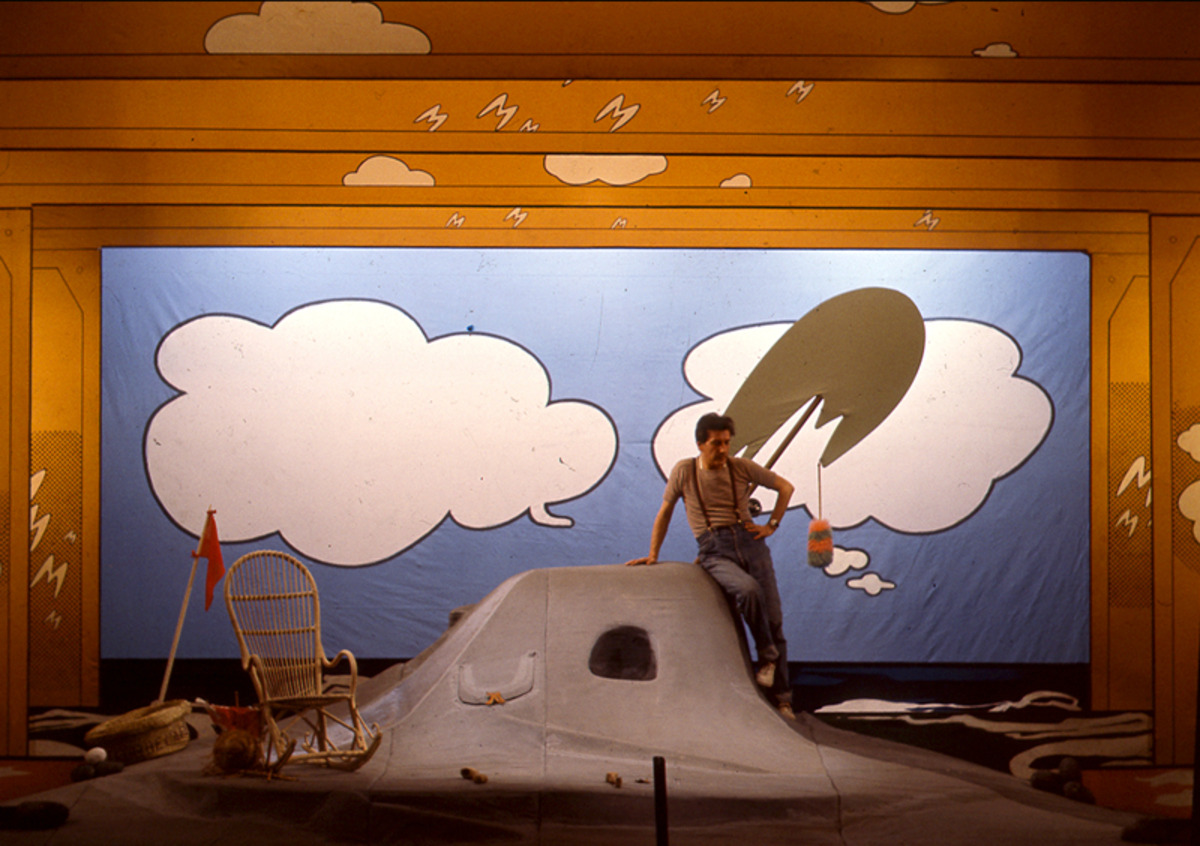
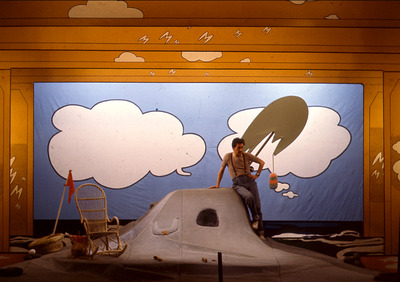
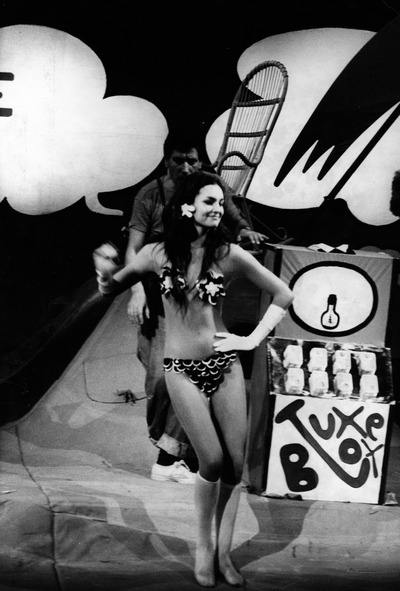
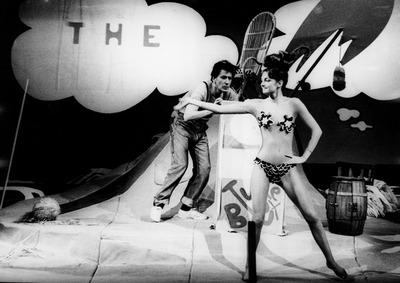
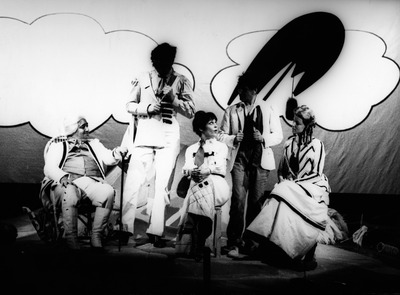
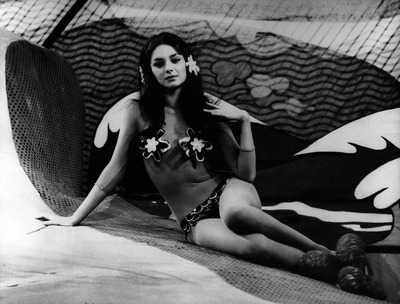
The sky, the sea and a small helmet-shaped island …The island’s sole inhabitant is Robinson Caruso, otherwise known as Omo, the stranded survivor of a shipwreck. On the island, Omo fishes, hunts for food, encounters mermaids and talking fish, converses with his conscience (represented by a Black woman), and with God Himself. Memories of his social life confront him in the form of a surreal warm wind with pale lights called Gron. He relives society’s hypocrisies, war and human instincts, as well as his erroneous marriages and old passions. Unlike Defoe’s Robinson Crusoe, so much does Omo enjoy his solitude that he avoids being seen or rescued. In fact, when the sea brings a castaway to keep him company, he gets rid of him. The play concludes with the inscription ‘The End’. Mauri wrote L’Isola in 1960. At that time, he made initial costume and set sketches. The premiere was planned for the Festival dei Due Mondi in Spoleto in 1964 However, as Mauri recounted, ‘After the semi-general rehearsal, the show did not go on due to reasons neither mysterious nor unspeakable. Just before opening night, the actors were exhausted by their efforts over the fortnight-long rehearsals. Everyone’s nervous system, including mine, had packed in, leading to the loss of the last four essential days to create this seemingly simple Island.’1 The play finally premiered on 13 February 1966, two years later, at the Teatro Stabile in Rome. The following year, L’Isola was adapted into German and staged at the Vienna Theatre. The play was also translated into French, English and Spanish, and directed by a number of people over the years. Referring to L’Isola, Mauri stated, ‘I employed all the experimental techniques of recent years. There’s the inner monologue, the joke, the surreal discourse, and the collage (with inserts ranging from the Bible to Molière, Pascal and Shakespeare).’² The play was widely acclaimed as the first Pop theatrical comedy, but Mauri preferred the description ‘theological comic’: ‘They are collages. Like in a painting. This doesn’t mean it’s a pop-play, or that it’s inspired by pop-art. Simply, in updating the play, I’ve utilised all my culture’s components to create an anthology collating the styles I like best.’³
1. Unpublished note, Fabio Mauri Archive, Rome
2. F. Mauri in Liliana Madeo, ‘Con L’Isola di Mauri la pop-art fa irruzione sulle scene italiane’, in Stampa Sera, Turin, 25 January 1966.
3. F. Mauri in Carmen Belli, ‘Le silhouettes di Mauri’, in Il Corriere di Roma, 15 March 1966.
1964, Spoleto, Festival dei Due Mondi – Caio Melisso, L’isola, July.
1966, Rome, Teatro Stabile, L’isola, 13 February.
1967, Vienna, Theater im Palais, Die Insel, December.
1967, Buenos Aires, Teatro ABC, L’isola (La Isla).
1972, Portici (Naples), Teatro Dialogo, L’isola, October.
Fabio Mauri, “L'Isola”, in Sipario, no. 219, Bompiani, Milan, July 1964, pp. 54–64, cover (ill.).
L’Espresso, Milan, 12 July 1964, p. 15 (ill.).
Costanzo Costantini, “Presto in scena a Roma la prima commedia Pop”, in Il Messaggero, 31 December 1965, .
Capitolium, Year XLI, no. 6, Rome, June 1966, p. 451 (ill.).
Almanacco Letterario Bompiani 1967, Bompiani, Milan, 1966, p. 187 (ill.).
Giordano Falzoni, “Uomo e Dio in un incastro Pop”, in Sipario, no. 239, Bompiani, Milan, March 1966, pp. 16–17 (ill.) .
Fabio Mauri, L’isola (Milan: Feltrinelli, 1966), .
L. L., “L’Isola”, in L’Isola (Rome: Teatro Stabile della città di Roma, theatre programme, 1966), n.p.
Sergio Ascanio, “Un po' di op e un po' di pop nella commedia di Fabio Mauri”, in Libertà, 12 February 1966, .
Carmen Belli, “Le silhouettes di Fabio Mauri”, in Corriere di Roma, 15 March 1966, .
Liliana Madeo, “Con L'Isola di Mauri la pop-art fa irruzione sulle scene italiane”, in Stampa Sera, 25 January 1966, .
Mario Guidotti, “Che cos’è l’avanguardia italiana”, in Le Ore, Year XIV, no. 16, 21 April 1966, pp. 34–36 (ill.).
Renzo Tian, “Ne «L’isola» di Fabio Mauri un naufrago che non vuole salvarsi”, in Il Messaggero, Rome, 15 February 1966, (ill.).
Ennio Flaiano, “Al nostro Robinson manca un venerdì”, in L’Europeo, Milan, 24 February 1966, p. 75 (ill.).
Grammatica \ Teatro, no. 2, Rome, January 1967, no. 6, p. 48 (ill.).
Ulf Birbaumer, “Robinson auf der Pop-“Insel”, in Salzburger Nachtrichten, 16 January 1968, p. 7.
Fabio Mauri, exhibition catalogue, Studio d’Arte Toninelli, Rome, edited by Cesare Vivaldi (Rome: Studio d’Arte Toninelli, 1969), pp. 65–72 (ill.).
Lara-Vinca Masini, Arte contemporanea. La linea dell’unicità: Arte come volontà e non rappresentazione (Florence: Giunti, 1989), p. 1065 (ill.).
Maurizio Calvesi, “Roma anni '60. Al di là della pittura”, in Roma Anni ’60. Al di là della pittura, exhibition catalogue, Palazzo delle Esposizioni, Rome, edited by Maurizio Calvesi, Rosella Siligato (Rome: Edizioni Carte Segrete, 1990), p. 200 (ill.).
Fabio Mauri: Male e bellezza – Das Böse und das Schöne, exhibition catalogue, Kunsthalle, Klagenfurt, edited by Arnulf Rohsmann (Klagenfurt, 1997), p. 16 (ill.).
“L’isola di Fabio Mauri”, in Enrico Job. Catalogo delle opere 1962-1996, edited by Dante Cappelletti, Franco Quadri (Venice: Marsilio, 1997), p. 20.
Lara-Vinca Masini, L’Arte del Novecento n.6: Dall’Espressionismo al Multimediale (Rome: Gruppo editoriale L’Espresso, 2003), p. 1065 (ill.).
Elisabetta Catalano, Le fotografie, edited by Laura Cherubini (Turin: Galleria Civica d’Arte Moderna e Contemporanea, 2005), p. 31 (ill.).
Fabio Mauri, Scritti in mostra. L’avanguardia come zona 1958-2008, edited by Francesca Alfano Miglietti (Milan: il Saggiatore, 2008), pp. 246–255 (ill.).
Fabio Mauri, Io sono un ariano (Milan: Lampi di stampa, 2009), pp. 41–46 (ill.).
Elisabetta Catalano, Work with Fabio Mauri, edited by Laura Cherubini (Milan: Maretti Editore, 2013), pp. 16–19 (ill.).
Fabio Mauri. Archivio di memoria, edited by Dionigi Mattia Gagliardi (Rome: Numero cromatico editore, 2015), pp. 96–97 (ill.).
Valérie Da Costa, Fabio Mauri: le passé en actes (Dijon: Les presses du réel, 2018), nn. 16–17, pp. 34–36 (ill.).