MATERIALS: Linocut on paper
DIMENSIONS: Sheet: 70 × 50 cm
Print: 61 × 41 cm
EDITION: Five numbered copies
CATALOGUE: G_1982_341
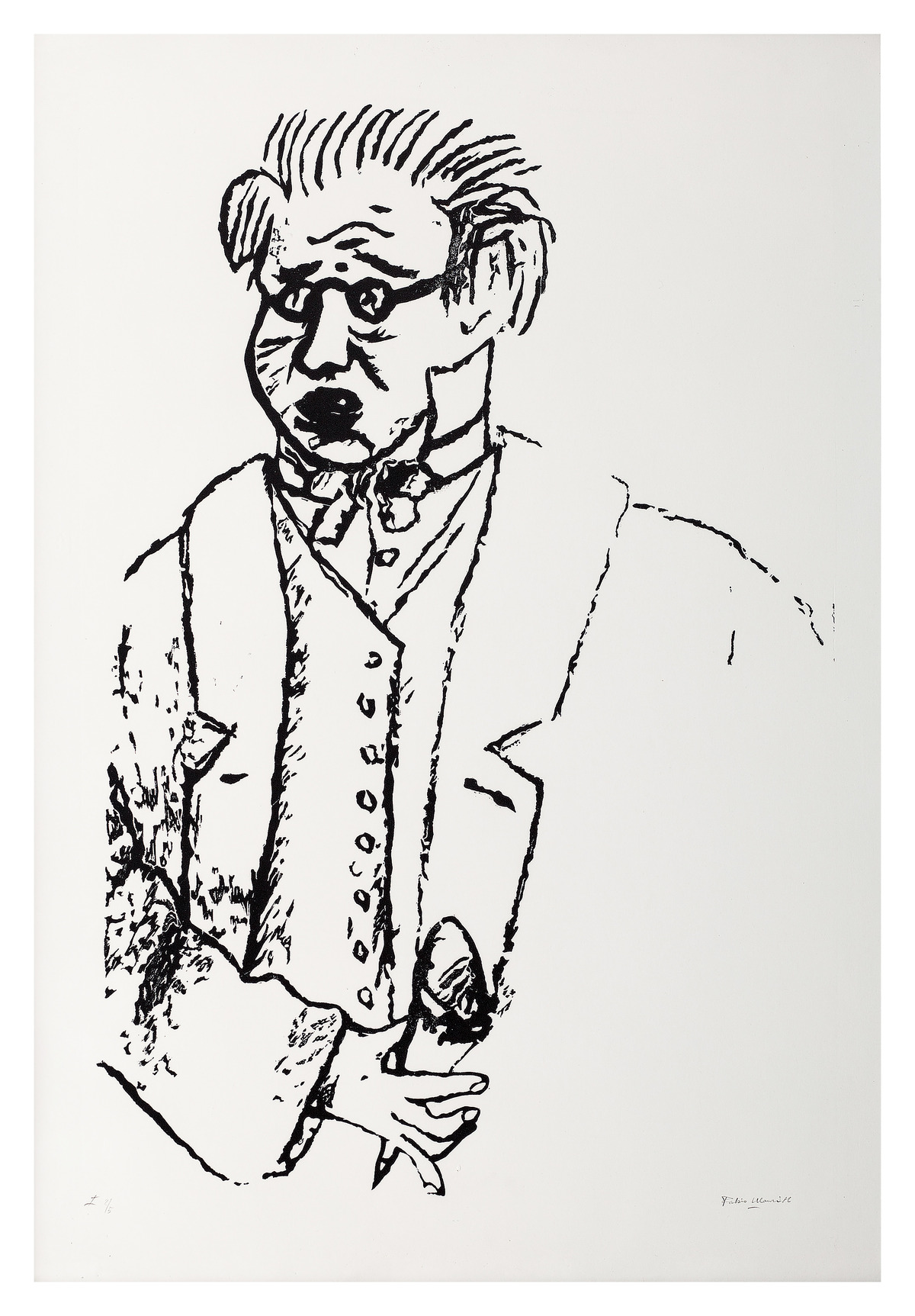
Linocut print on paper, Il bene e il male parlano la stessa lingua reproduces a juvenile drawing executed by Adolf Hitler: a portrait of one of his teachers. ‘In Antica performance, 1982 […] I displayed an enlarged drawing on the desks at Adolf Hitler’s school: very expressionist. Meaning to suggest that style, for better or worse, is an era. The same era. An “insignificant historical event”, from a certain point of view. The era’s style establishes a social dramaturgy. Each element of difference blends into a dramaturgical compactness, specifically, into linguistic unrecognisability. Does art have the ability to transform the most brutal history into a Fable? To arrange related elements of deep ethical discomfort, only in relation to stylistic compactness, which is beauty? An unbearable phenomenon. Ideology, or fierce attentiveness to the reality of one’s own time, has this demerit: to direct its sharp attention to what it primarily pursues: to the gesture and use of its own language, unintentionally or intentionally manipulative.”1
1. F. Mauri, ‘Storia di un manifesto mancato’, in F. Mauri, Scritti in mostra. L’avanguardia come zona 1958-2008, edited by Francesca Alfano Miglietti (Milan: il Saggiatore, 2008), p. 217.
1982, Falconara (Ancona), Galleria del Falconiere, Antica Performance (action), in Fabio Mauri. Antica Performance, 23 November.
1988, Rome, Istituto San Michele, L’Arte contro l’AIDS, 8–18 February.
1996, Chiesanuova di Treia (Macerata), Per Mari e Monti, Laboratorio politico di fine secolo, 28 September – 31 October, curated by Gabriele Perretta.
1997, Klagenfurt, Kunsthalle, Fabio Mauri. Male e bellezza / Das Böse und das Schöne, 24 April – 30 June, curated by Arnulf Rohsmann.
1997-1998, Milan, Studio Casoli, Fabio Mauri: Autobiografia come teoria, 12 November 1997 – 12 January 1998.
1998, Castelluccio di Pienza (Siena), Galleria La Tartaruga, Picnic o Il buon soldato, 5 September – 11 October, curated by Benedetta Origo, Plinio De Martiis.
1999, Barcelona, Fundació “La Caixa”, La meva cosina Marcella i la guerra civil, 29 January – 21 March, curated by Martí Peran.
1999, New York, PS1, 100 drawings, 18 April – 20 June.
2012, Kassel, Museum Fridericianum, dOCUMENTA(13), 9 June – 16 September, curated by Carolyn Christov-Bakargiev.
2023-2024, Rivoli (Turin), Castello di Rivoli Museo d’Arte Contemporanea, Fabio Mauri. Experiments in the Existence of Evil, 16 December 2023 – 24 March 2024, curated by Carolyn Christov-Bakargiev, Sara Codutti, Marianna Vecellio.
Giulio Angelucci, “L'indiscrezione ossessa. Fabio Mauri al Falconiere di Ancona”, in Stilb, Year III, no. 12–13, Rome, 1982, p. 112 (ill.).
L’arte contro l’Aids (Rome: Edizioni Lavoro Italiano, 1988), no. 58, p. 145 (ill.).
Utopie quotidiane: L’uomo e i suoi sogni nell’arte dal 1960 a oggi, exhibition catalogue, PAC Padiglione d’Arte Contemporanea, Milan, edited by Vittorio Fagone, Angela Madesani (Cinisello Balsamo: Silvana Editoriale, 2002), p. 132.
dOCUMENTA (13). Das Logbuch / The Logbook, exhibition catalogue, Museum Fridericianum, Kassel, edited by Carolyn Christov-Bakargiev (Ostfildern: Hatje Cantz, 2012), p. 161 (ill.).