

PERFORMER: 15 actors, a philosopher, a cellist, a dancer
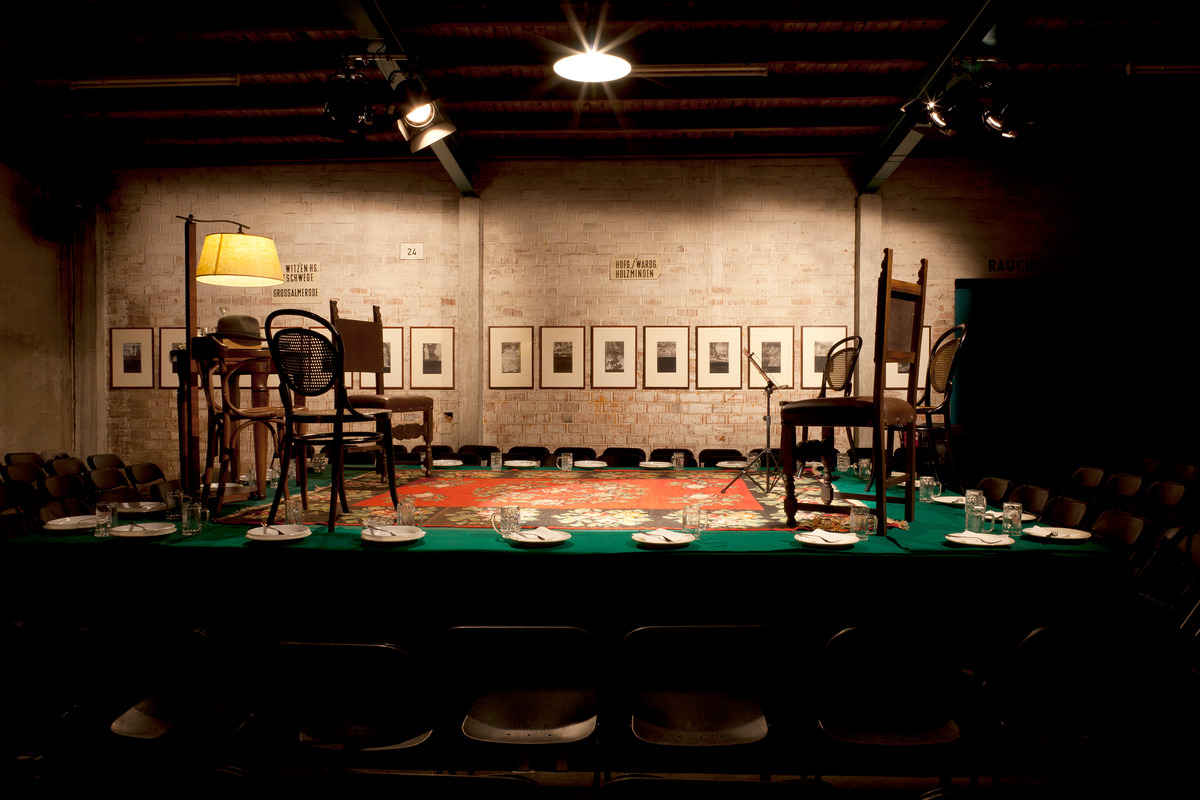
PROPS: A big table, a carpet, a coffee table, a lamp, 6 chairs above the table, 24 chairs around the table, plates, cutlery and beer mugs, 15 framed lithographs of Manipolazione di cultura (inv. 1050)
DIMENSIONS: Variable
Table: 319 × 359 cm
Carpet: 282 × 219 cm
Frames: 73 × 53 cm each
DURATION: Variable, about 60 min.
DOCUMENTATION: Photographs, script, video
RE-ENACTMENTS: Yes
COLLECTION: Fabio Mauri Estate, Rome
CATALOGUE: P_1989_3396
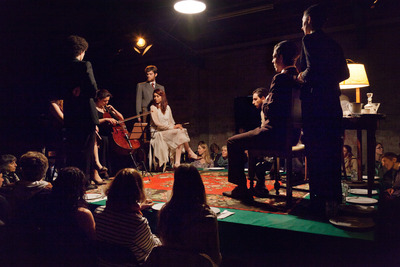
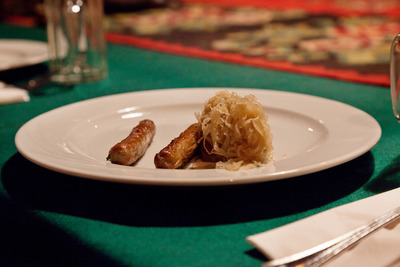
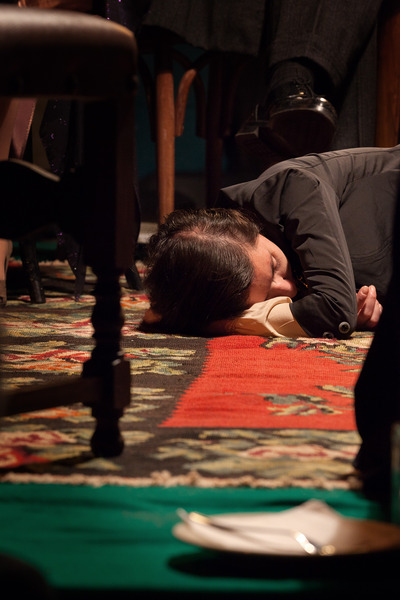
A large, square table in the centre of a room becomes the stage and the centre of an action. The scene takes place on two levels: on the table, seven performers, a philosopher and a cellist represent the educated, bourgeois German class. A rug, a lamp, a small table and chairs, arranged in a circle above the table-stage, suggest an intellectual salon where elegantly dressed participants drink tea, quote verses, play dodecaphonic music and discuss philosophy. Around the table perimeter sit Volk, the German ‘people’, an audience invited by some of the actors to take part in the banquet. Waitresses in traditional costume serve frankfurters, sauerkraut and beer, accompanied by folk music. Fifteen plates from the work Manipolazione di cultura (inv. 848) hang on the walls. In one corner, a performer with a megaphone translates the dialogue recited in German into Italian. The philosopher Giacomo Marramao1 read out passages in German from Martin Heidegger’s essay Was ist das, die Philosophie?2 The nineteen scenes in the action were interspersed with a kind of refrain, only seemingly the same, when the actors danced and quoted verses ‘taken at random, or for phonetic reasons from Becher, Heym, Lichtenstein, Werfel and Rilke’3 to the strains of Arnold Schönberg, Anton Webern and Alban Berg played by the cellist. This sequence was interrupted twice: by an expressionist dancer dressed in black, and by an off-screen radio voice reading out excerpts from the Eichmann trial on the economic exploitation of bodies in Nazi concentration camps, insinuating horror into this refined speculative weave. The ‘German question’ – for Mauri, an emblem and cipher of the European question – was represented here through a circular-structured theatrical stage where a search for the deepest origins at the roots of the Greek logos φιλοσοφία (philosophy), ended up twisting in on itself and losing the direction of its own ‘path’,4 singing a national anthem dense with foreboding. As was so often the case in Mauri’s performances, the audience was a witness: seated at the banquet of ideology, viewers participated in the spiritual exercise of re-presentation. The performance ended with the artist walking on stage, standing on the table and reading from a text that nailed down the meaning of the action: ‘But what do I want to demonstrate precisely in this “table concert”? That the difference between Evil and Good speaks the same language? Sure, yes, “that was obvious” some might say. What I wanted to find out here are the same things you already know […] The obvious and common sense are more mysterious to me than depth and enigma.’
1. The artist chose Giacomo Marramao, a renowned philosopher and close friend to play the role of Heidegger. He actively participated in developing the performance, selecting the text and passages cited.
2. M. Heidegger, Was ist das, die Philosophie?, Günther Neske, Pfulligen 1956; here in the Italian translation by Carlo Angelino, published by il melangolo, Genoa, 1981.
3. From the stage script. It refers to poets Johannes Robert Becher, Georg Heym, Alfred Lichtenstein, Franz Werfel and Ranier Maria Rilke.
4. Heidegger defines the concept of philosophy in wording cited during the performance: ‘The word “philosophy” speaks Greek. As a Greek word, the word is a path along which we travel, determining the profound foundation of our Western European history.’
1989, L’Aquila, Multimedia center “Quarto di Santa Giusta”, Heidegger e la questione tedesca. Concerto da tavolo, 16 May.
1990, Florence, Galleria Carini, Che cosa è la filosofia: Heidegger e la questione tedesca, 12 May.
1993, Prato, Centro per l’Arte Contemporanea Luigi Pecci, Inside Out, 27 March – 16 May, curated by Ida Panicelli.
1994, Rome, Galleria Nazionale d’Arte Moderna e Contemporanea, Fabio Mauri. Opere e Azioni 1954-1994, 21 June – 5 October, curated by Carolyn Christov-Bakargiev, Marcella Cossu.
2012, Kassel, Museum Fridericianum, dOCUMENTA(13), 9 June – 16 September, curated by Carolyn Christov-Bakargiev.
Giacomo Marramao, “Heidegger e la questione tedesca”, in Art E tra, no. 2, Centro multimediale "Quarto di Santa Giusta", edited by Enrico Sconci, L'Aquila, May 1990, pp. 12–15 (ill.).
Inside Out. Museo città eventi, exhibition catalogue, Museo Pecci, Prato, edited by Ida Panicelli, Antonella Soldaini (Milan: Charta, 1993), pp. 92–95, 102–104, no. 59 (ill.).
Domenico Scudero, “Impressioni ideologiche”, in Art in Italy, no. 2, Verona, 1993, p. 14 (ill.).
Franco Di Matteo, “La seduzione glaciale di Fabio Mauri”, in Casting, Rome, November 1993, p. 44 (ill.).
Fabio Mauri. Opere e Azioni 1954-1994, exhibition catalogue, Galleria Nazionale d’Arte Moderna e Contemporanea, Rome, edited by Carolyn Christov-Bakargiev, Marcella Cossu (Milan / Rome: Editoriale Giorgio Mondadori / Carte Segrete, 1994), pp. 45, 218–227 (ill.).
Cinzia Fiori, “Heidegger e Marramao: che scandalo il pensiero filosofico”, in Corriere della Sera, Milan, 21 July 1994, p. 28 (ill.).
Nutrimenti dell’arte, exhibition catalogue, La Salerniana, Erice, edited by Achille Bonito Oliva (Milan: Charta, 1995), pp. 88–89 (ill.).
Fabio Mauri: Male e bellezza – Das Böse und das Schöne, exhibition catalogue, Kunsthalle, Klagenfurt, edited by Arnulf Rohsmann (Klagenfurt, 1997), pp. 48–60 (ill.).
Fabio Mauri. Picnic o il buon soldato, exhibition catalogue, Galleria La Tartaruga, Castelluccio di Pienza (Siena), edited by Plinio De Martiis (San Quirico d’Orcia, Siena: Editrice DonChisciotte, 1998), p. 46 (ill.).
Floriano De Santi, “L'arte di Fabio Mauri: un inventario per dare al presente il senso della vita”, in Teléma, Year VI, no. 20, Fondazione Ugo Bordoni, Rome, Spring 2000, p. 123 (ill.).
Angelo Capasso, “Intervista a Fabio Mauri”, in Homo Sapiens, Year IV, no. 5–6, Teseo editore, Rome, May 2001, pp. 87–103.
Fiodor Sologub, La luce e le ombre (Rome: Edizioni Kami, 2003), cover (ill.).
Adachiara Zevi, “L'arte ‘saggistica’ di Fabio Mauri”, in L’architettura – cronache e storia, no. 575, Rome, 2003, p. 669 (ill.).
Laura Cherubini, “Fabio Mauri. Un pensiero fisico”, in Flash Art, Year XL, no. 266, Milan, October–November 2007, pp. 81–82 (ill.).
Fabio Mauri. L’universo d’uso, exhibition catalogue, Auditorium Parco della Musica, Rome, edited by Francesca Alfano Miglietti (Milan: Skira, 2008), pp. 22–51 (ill.).
Fabio Mauri, Scritti in mostra. L’avanguardia come zona 1958-2008, edited by Francesca Alfano Miglietti (Milan: il Saggiatore, 2008), pp. 74–77 (ill.).
Laura Cherubini, “Conversazioni. Ricordando Fabio Mauri”, in Flash Art, Year XLII, no. 277, Milan, August–September 2009, p. 51 (ill.).
Fabio Mauri, Io sono un ariano (Milan: Lampi di stampa, 2009), pp. 267–276 (ill.).
Elena Pirazzoli, A partire da ciò che resta. Forme memoriali dal 1945 alle macerie del Muro di Berlino (Reggio Emilia: Diabasis, 2010), pp. 36, 67 (ill.).
Barbara Casavecchia, “Body Politics”, in Frieze, no. 147, London, May 2012, p. 185 (ill.).
Laura Cherubini, “What Philosophy Is. Heidegger and the German Question. Table Concert”, in Fabio Mauri. Ideology and Memory, edited by Studio Fabio Mauri (Turin: Bollati Boringhieri, 2012), pp. 141–153 (ill.).
Federica Boràgina, Fabio Mauri. Che cosa è, se è, l’ideologia nell’arte (Catanzaro: Rubbettino editore, 2012), pp. 104–113, no. 27 (ill.).
Elisabetta Catalano, Work with Fabio Mauri, edited by Laura Cherubini (Milan: Maretti Editore, 2013), pp. 104–106 (ill.).
Ennesima. Una mostra di sette mostre sull’arte italiana, exhibition catalogue, Palazzo della Triennale, Milan, edited by Vincenzo De Bellis (Milan: Mousse Publishing, 2015), Vol. “La performance dal tempo sospeso: il tableau vivant tra realtà e rappresentazione”, pp. 89 (ill.), 69–73.
Fabio Mauri. Archivio di memoria, edited by Dionigi Mattia Gagliardi (Rome: Numero cromatico editore, 2015), pp. 162.165 (ill.).
Delta ti: In tempo reale, exhibition catalogue, Museo Carlo Bilotti, Rome (Rome: Nero, 2015), p. 88 (ill.).
Valérie Da Costa, Fabio Mauri: le passé en actes (Dijon: Les presses du réel, 2018), nn. 93–98, pp. 164–175 (ill.), 307–313.
Giacomo Marramao, L’esperimento del mondo: Mistica e filosofia nell’arte di Fabio Mauri (Turin: Bollati Boringhieri, 2018), no. 4, (ill.), pp. 65–81.
Valérie Da Costa, “Fabio Mauri: un théâtre sans théâtre”, in Art, performance, manœuvre, coefficients de visibilité, edited by Michel Collet, André Éric Létourneau (Dijon: Les presses du réel, 2019), p. 86 (ill.).
Laura Cherubini, Contro corrente: I grandi solitari dell’arte italiana: Alighiero Boetti, Gino De Dominicis, Luciano Fabro, Fabio Mauri, Vettor Pisani, Marisa Merz (Milan: Christian Marinotti edizioni, 2020), pp. 118–120 (ill.).
Elisabetta Catalano: Tra immagine e performance, exhibition catalogue, MAXXI Museo nazionale delle arti del XXI secolo, Rome, edited by Laura Cherubini, Aldo Enrico Ponis (Imola: Manfredi Edizioni, 2020), p. 81 (ill.).
Mauri, edited by Flaminio Gualdoni (Milan: Corriere della Sera, 2022), pp. 62–63 (ill.).