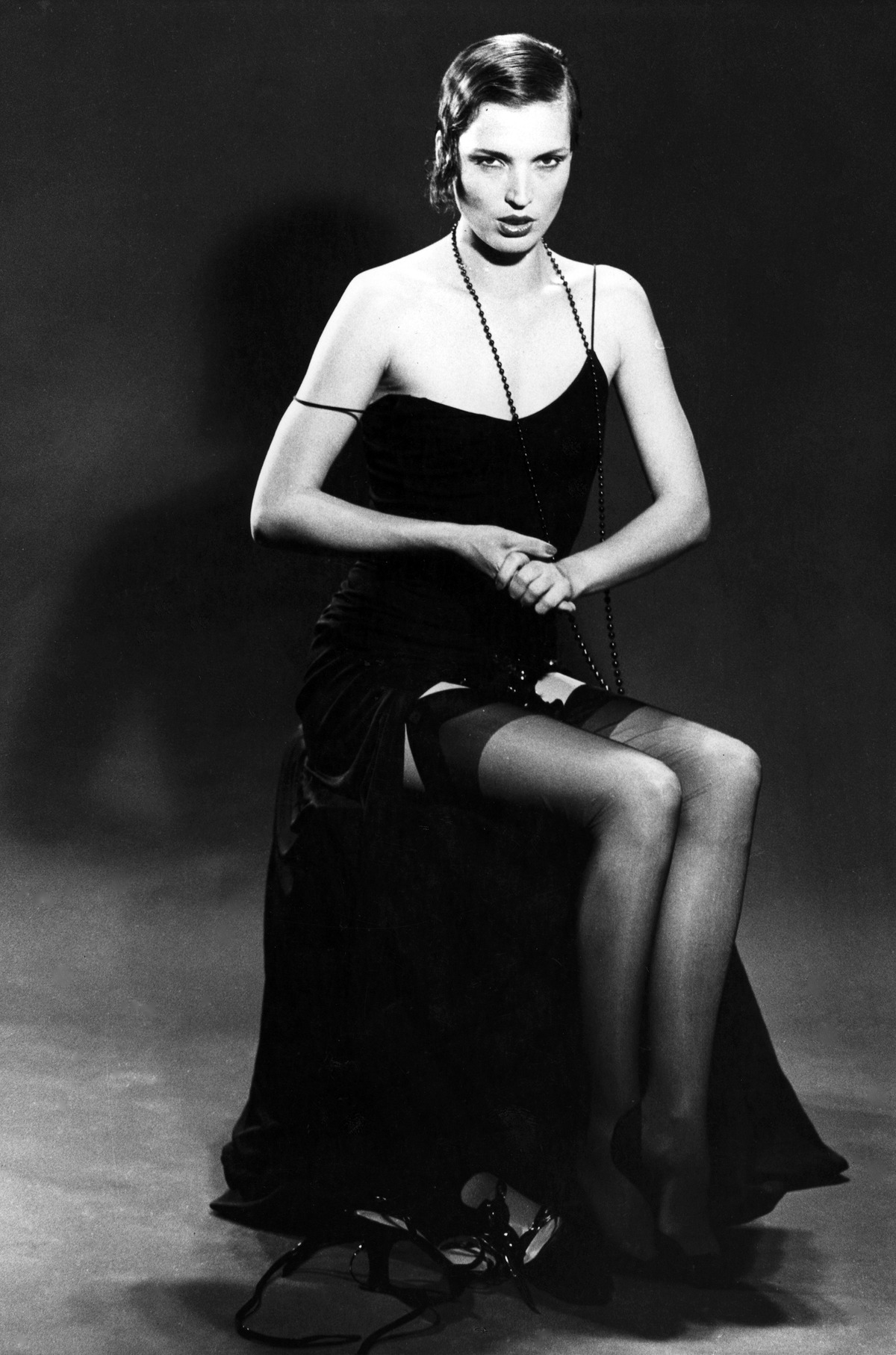


Signboard: 35.5 × 59.5 cm
Photograph: 200 × 95 cm
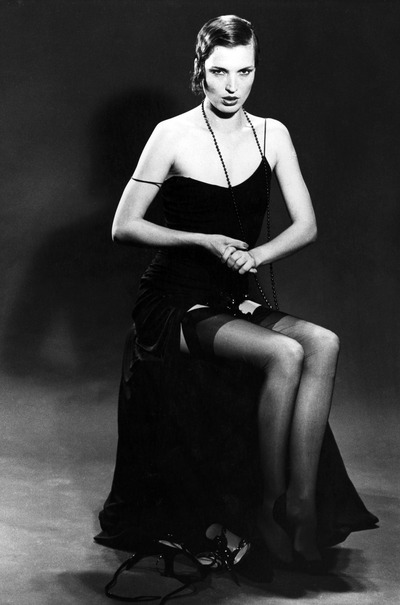
Photograph: 105 × 139 cm
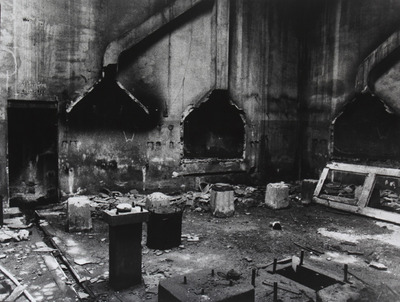
Photograph: 105 × 139 cm
Chair: 40 × 45 × 80 cm
PHOTOGRAPHY: Elisabetta Catalano
CATALOGUE: P_1978_3323
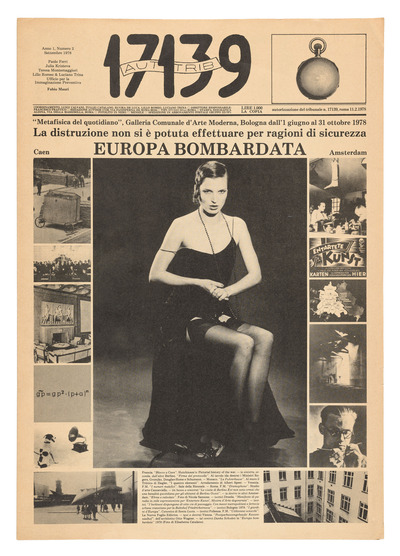
Europa bombardata was a performance scheduled to take place at the church of Santa Lucia in Bologna in 1978. It was cancelled for ‘security reasons’ and presented in different form sixteen years later at the Galleria Nazionale d’Arte Moderna di Roma. Invited to take part in the ‘Metafisica del quotidiano’ (Everyday Metaphysics) exhibition, Mauri had planned an intervention in the deconsecrated church of Santa Lucia, which he had attended during his Fascist high-school years, when it had been a gymnasium for the Liceo Galvani high school. ‘Through a trail of vintage or personally owned objects, carpets, armchairs, lamp covers, a pair of boxing gloves, the artist’s intent was to recreate a historical memory of the Fascist period in Bologna, using fragments from private memory.’1 The exhibition was to have been held in the rear portion of the church, where a closed-down, dilapidated pottery workshop brought back memories of the crematorium ovens of Buchenwald concentration camp. On the opening day there was to be a ‘performance of a private party of German high society from the early days of Nazism’,2 featuring model Danka Schroder in the role of ‘Young Germany’, and the orchestra from the Caffè Florian in Venice playing live. Just weeks before opening, Mauri was officially prevented from installing the work because of the unsafe nature of the site, a motivation that likely concealed more concrete political opposition and fears of yet another scandal.3 Mauri’s intervention was thus reduced to displaying the horse from Ebrea (inv. 311) in the nave of the church – later moved to the halls of the Galleria d’Arte Moderna – next to the Cassa Armonica (Sound Box) by young Apulian artist Franco Dallerba, beneath which other concerts and events were held. Embittered by the incident, Mauri had photographs of the empty church published in the exhibition catalogue along with the stinging sentence, ‘This destruction could not be carried out for security-related reasons.’ This sentence went on to become the cover title of independent magazine Aut. Trib. 17139, which featured a beautiful full-page photograph of Danka Schroder taken in Elisabetta Catalano’s studio. In 1994, as part of a retrospective at the Galleria Nazionale d’Arte Moderna di Roma, Europa bombardata was re-enacted in action form with Schroder herself sitting on a chair, dressed exactly as in the 1978 photo, reading aloud passages from Thomas Bernhard’s novel Alte Meister (Old Masters). Behind her were two large images of the Bologna church of Santa Lucia and a photograph of Schroder taken sixteen years earlier: mirroring one another, image and performer reflected a fascinating, elegant and cultured Europe, first seduced and then bombed by Nazi-Fascist ideology endorsed by an intelligentsia charmed by Heidegger, against whom, in Alte Meister, teacher Atzbacher lashes out in memorable pages from the book. This repetition of the performance at a chronological distance with the same model added historical depth to a work in which political and personal memory merged into a collage of the living.
1. M. Cossu, ‘Europa bombardata’, in Fabio Mauri. Opere e Azioni 1954–1994, catalogue of the exhibition (Galleria Nazionale d’Arte Moderna e Contemporanea, Roma, 1994), edited by C. Christov-Bakargiev, M. Cossu, Editoriale Giorgio Mondadori / Carte Segrete, Milan / Rome, 1994, p. 190.
2. Ibid.
3. The scandal caused by Hermann Nitsch’s bloody performance, which had been presented in the same church the previous year, still rumbled on; after the controversies stirred up by his Ebrea work, Mauri was known as a politically controversial artist.
1994, Rome, Galleria Nazionale d’Arte Moderna e Contemporanea, Fabio Mauri. Opere e Azioni 1954-1994, 21 June – 5 October, curated by Carolyn Christov-Bakargiev, Marcella Cossu.
2016-2017, Naples, Museo Madre, Retrospettiva a luce solida, 26 November 2016 – 6 March 2017, curated by Laura Cherubini, Andrea Viliani.
2018, New York, Hauser & Wirth, With Out, 25 January – 7 April, curated by Olivier Renaud-Clément.
Metafisica del quotidiano, exhibition catalogue, Galleria Comunale d’Arte and Church of Santa Lucia, Bologna, edited by Franco Solmi, Marilena Pasquali (Bologna, 1978), pp. 45–46.
Auttrib 17139, Year 1, no. 2, Uffici per la Immaginazione Preventiva, Rome, September 1978, cover (ill.).
L’Immagine, edited by Giovanni Damiani (Milan: Pragma Libri / Carlini editore, 1989), pp. 36, 38 (ill.).
Francesca Alfano Miglietti, Arte Pericolosa (Milan: Prearo Editore, 1991), p. 142 (ill.).
Fabio Mauri. Opere e Azioni 1954-1994, exhibition catalogue, Galleria Nazionale d’Arte Moderna e Contemporanea, Rome, edited by Carolyn Christov-Bakargiev, Marcella Cossu (Milan / Rome: Editoriale Giorgio Mondadori / Carte Segrete, 1994), cover, pp. 190–193 (ill.).
Fabio Mauri: Male e bellezza – Das Böse und das Schöne, exhibition catalogue, Kunsthalle, Klagenfurt, edited by Arnulf Rohsmann (Klagenfurt, 1997), pp. 10, 46 (ill.).
Elisabetta Catalano, Le fotografie, edited by Laura Cherubini (Turin: Galleria Civica d’Arte Moderna e Contemporanea, 2005), p. 228 (ill.).
Laura Cherubini, “Conversazioni. Ricordando Fabio Mauri”, in Flash Art, Year XLII, no. 277, Milan, August–September 2009, p. 52 (ill.).
Fabio Mauri, Io sono un ariano (Milan: Lampi di stampa, 2009), pp. 205–210 (ill.).
Federica Boràgina, Fabio Mauri. Che cosa è, se è, l’ideologia nell’arte (Catanzaro: Rubbettino editore, 2012), pp. 75–76, no. 17, p. 76 (ill.).
Elisabetta Catalano, Work with Fabio Mauri, edited by Laura Cherubini (Milan: Maretti Editore, 2013), pp. 60–63 (ill.).
Valérie Da Costa, Fabio Mauri: le passé en actes (Dijon: Les presses du réel, 2018), nn. 88–89, pp. 156–157 (ill.).
Elisabetta Catalano: Tra immagine e performance, exhibition catalogue, MAXXI Museo nazionale delle arti del XXI secolo, Rome, edited by Laura Cherubini, Aldo Enrico Ponis (Imola: Manfredi Edizioni, 2020), pp. 74–83 (ill.).
Hidden Displays 1975-2020: Progetti non realizzati a Bologna, exhibition catalogue, MAMbo – Museo d’Arte Moderna di Bologna, Bologna, edited by Elisabetta Modena, Valentina Rossi (Bologna: MAMbo – Museo d’Arte Moderna di Bologna, 2021), pp. 68–69.
Sara Codutti, “Fabio Mauri, Bologna 1938-1978: poesia, ideologia, azione”, in La performance a Bologna negli anni ’70, edited by Uliana Zanetti (Bologna: Settore Musei Civici Bologna / MAMbo – Museo d’Arte Moderna di Bologna, 2023), pp. 266–267 (ill.).