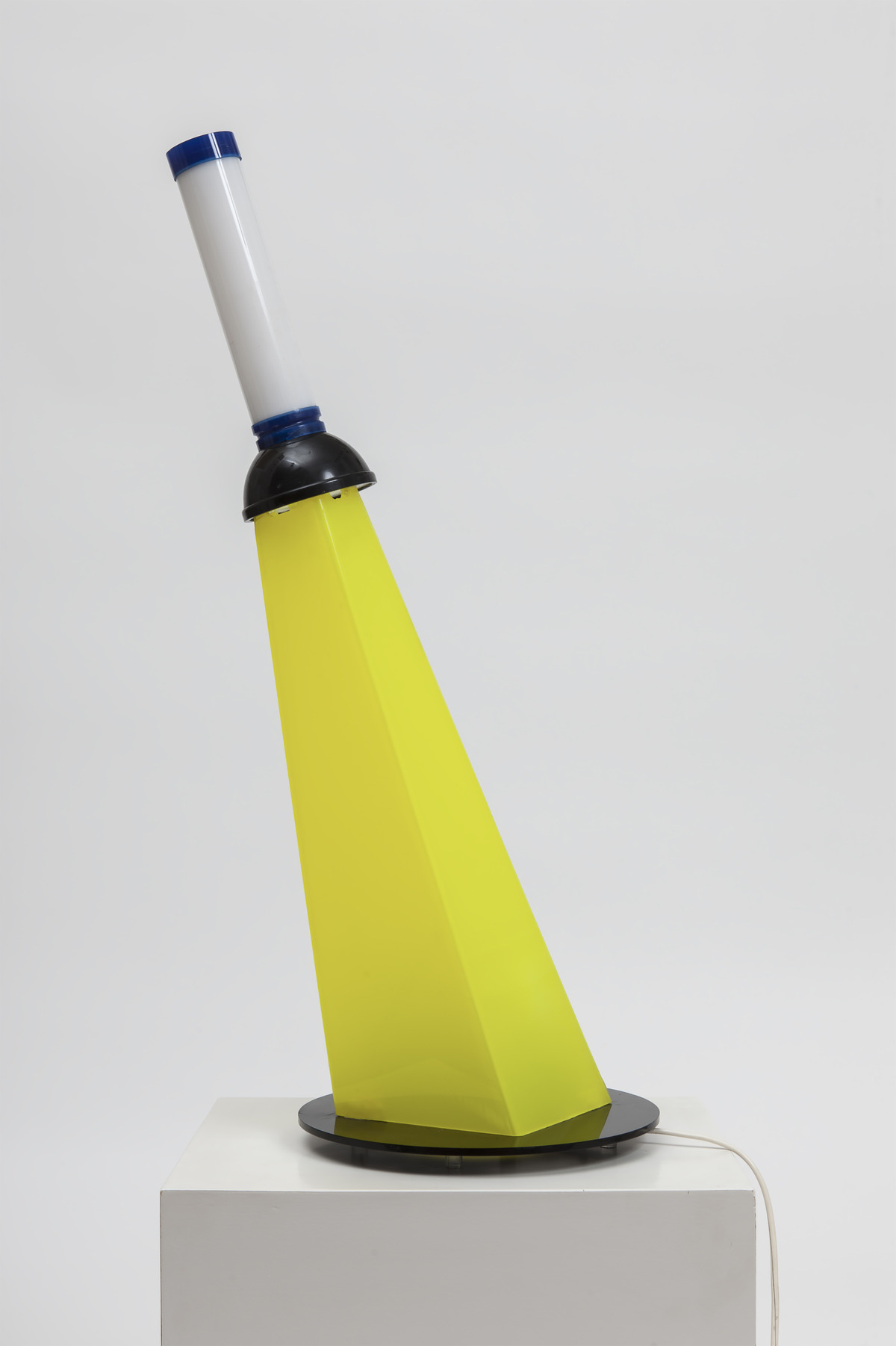
MATERIALS: Methacrylate sculpture, electric light
DIMENSIONS: 76.5 × 27 × 27 cm
EDITION: Unknown. Four unnumbered copies known
PROVENANCE: The artist; Galleria La Steccata, Parma
COLLECTION: Giorgio Teglio, Genoa
CATALOGUE: O_1968_212
Fabio Mauri designed the Pila a luce solida methacrylate table lamp for the Mana Art Market in Rome in 1968.1 The work consists of three elements: an upper handle shaped like a portable tubular flashlight; a beam of ‘solid light’, which is in fact a hollow pyramidal section that, with a light bulb inside, illuminates when the torch is turned on, and a thin, slightly raised circular base from which an electric cable and switch emerge. Like the other items in the Mana Art Market, Pila a luce solida was conceived as a multiple work (edition unknown), however in unique versions of differing colour combinations. Mauri designed two prototypes, each slightly different, the first of which (inv. 3399) was likely never produced. Indeed, the gallery only marketed the second model, a few examples of which are still known (inv. 212, 1113, 1554, 3504). Inspired by Futurist painting, the idea of a ‘solid’ ray of light was articulated in three dimensions here, citing the solidified light beams that Futurist artist Fortunato Depero described in his manifesto Architettura della luce (1927). For Mauri, Luce solida (Solid Light) of which the Mana Art Market lamps were the first example, provided a vehicle for projection and a metaphor for thought. In representing light as a solid body, the artist was keen to convey that, like a weight, light physically changes the initial condition of reality by striking it: ‘For me, light and thought are “things”. A wrong thought is equivalent to a distorted track, a risky object, one that is seriously messed up.’2 The Pile a luce solida would evolve into his Cinema and Colonne di luce series (inv. 210, 1156), also made for the Mana Art Market, in which the beam became a prism, a crystallised expression of a projected light beam.
1. See also Disco bianco, inv. 1120.
2. F. Mauri in A. Madesani, Le icone fluttuanti, Bruno Mondadori, Milan, 2002, p. 177.
1968, Rome, Mana Art Market, Mana Art Market – Opening, 29 February.
1969, Rome, Studio d’Arte Toninelli, Fabio Mauri 1959-1969, opening 1 July, curated by Cesare Vivaldi.
1969, San Benedetto del Tronto (Ascoli Piceno), Palazzo Scolastico Gabrielli and interventions in the landscape, Al di là della pittura: VIII Biennale Arte Contemporanea, 5 July – 28 August, curated by Luciano Marucci, Gillo Dorfles, Filiberto Menna.
Mana Art Market, exhibition catalogue, Mana Art Market, Rome (Rome, 1968), n.p. (ill.).
VIII Biennale d’Arte San Benedetto del Tronto: Al di là della pittura, exhibition catalogue, Palazzo Scolastico Gabrielli, San Benedetto del Tronto, edited by Luciano Marucci, Gillo Dorfles, Filiberto Menna (Florence: Centro Di Edizioni, 1969), n.p. (ill.).
Il “Mana” di Nancy Marotta, edited by Stefano Marotta, Andrea Orsini (Rome: Es Architetture, 1995), n.p. (ill.).