

PROPS: A gramophone, a record player, 3 Dramophone drawings, a basket of red carnations, 2 large-format photographs, an armchair
DURATION: Unknown
DOCUMENTATION: Photographs, notes
RE-ENACTMENTS: None
CATALOGUE: P_1976_1136
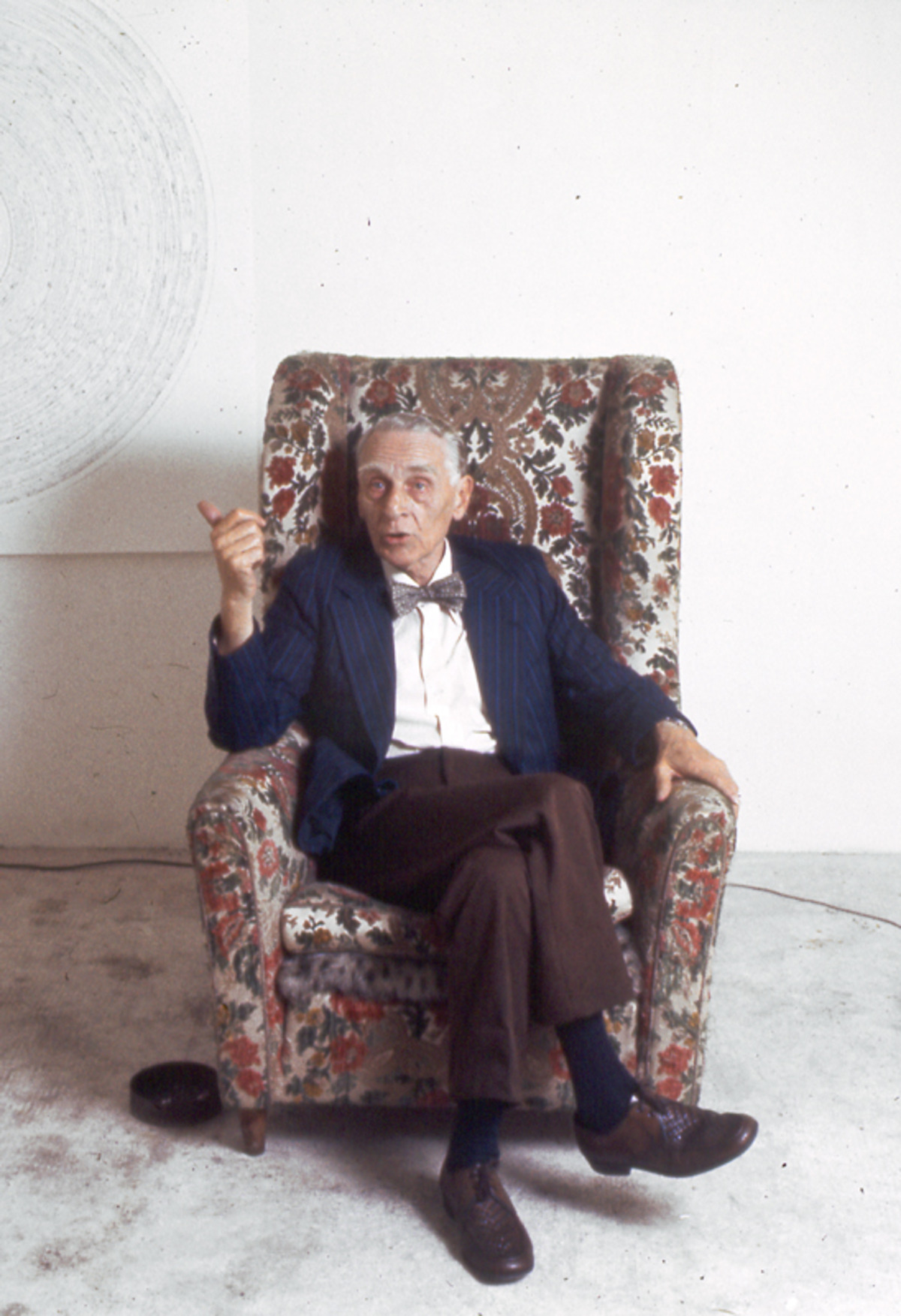
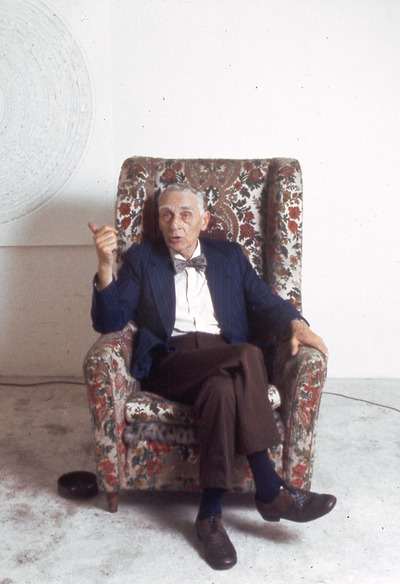
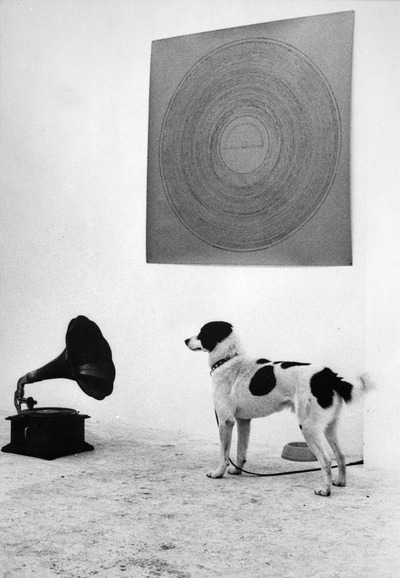
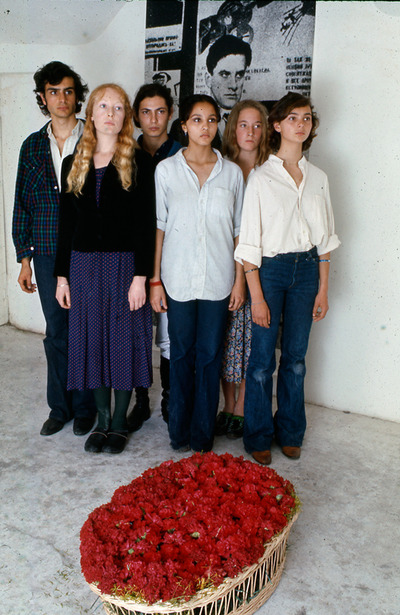
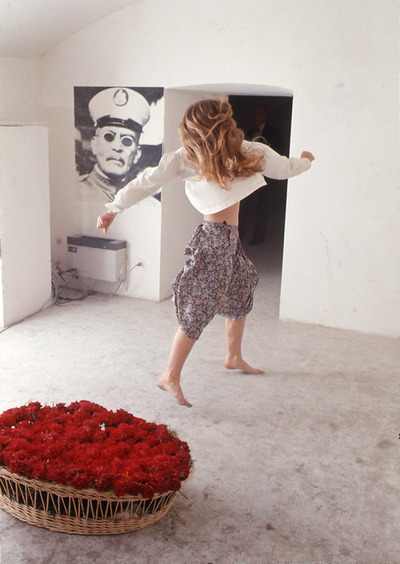
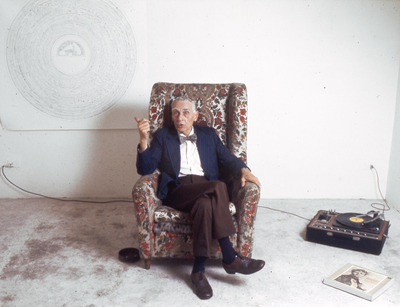
An action in three acts or ‘stations’, presented at the Studio d’arte Cannaviello in Rome on 5, 8 and 11 May 1976. Three performative moments followed one another in the gallery’s three rooms. In the first room, in Pessimismo, a live dog stood in front of a gramophone, in eloquent representation of Francis James Barraud’s painting that became the logo for the famous record label, ‘His Master’s Voice’. A drawing on paper with concentric circles made in pencil hung on the wall above them, ‘the universe/disc already recorded: history as already imprinted, in circles, around an abnormal emblem’.1 In the second ‘station’, two giant photographs, one of poet Vladimir Mayakovsky, the other of dictator Victoriano Huerta, adorned the walls. Seven young performers ‘sing and dance with their own grace between these two focuses’,2 while in the middle of the room a basket of red carnations stands on the floor, a symbol of life, struggle, blood, perhaps even death. Entitled Scetticismo e dolore (Scepticism and Pain), this ‘station’ was a reference to young people used as ‘the bodies of massacre (for reasons of nature, for culture, because of time and history, as already inscribed on the world/disc, which removes them from the very condition of youth, exposing them as direct experimenters of utopia).’3 In the final station, Cinismo, psicologia e virtù razionale, seventy-seven-year-old Feodor Chaliapin Jr., son of a celebrated Russian singer, sat in a floral armchair, recounting the vicissitudes of a life packed with major historical events: childhood under the regime of the czars, the October Revolution, the rise of Nazism in Germany, New Deal America, the landing of the Allies in Europe … ‘Those who have long survived have survived Chance and History, both of which are accidents.’ The speaker’s testimony was ‘projected memory, because all he glimpses is the present. In a simulated sequence, he naturally disassembles this plot into segments of the present. His words cover the inclination of fate, its first historical circuit of meaning […] Faced with the past-present, the condition of the self is metahistorical.’4 This action would never be repeated in this form. In 1994, for the retrospective at the National Galleria d’Arte Moderna, Mauri reprised Dramophone in the form of an installation, activated on opening day by Bella Levensohn, aka Cha Landres, Chaliapin’s friend and collaborator, who read a text in his memory while talking in Russian to actor Dimitri Tamarov, who conversed from the audience (inv. 3328).
1. F. Mauri, ‘Dramophone’, 1976, in Imprinting: sperimentazione e linguaggio, edited by C.M.Benveduti, T. Catalano, F. Falasca, Rome, 1976, p. 157.
2. Ibid., p. 158.
3. Ibid.
4. Ibid., p. 160.
1976, Rome, Studio d’Arte Cannaviello, Dramophone (action), in Fabio Mauri. Dramophone, 5, 8, 11 May.
Catalogo nazionale Bolaffi. Segnalati Bolaffi 1977 - 59 artisti scelti da 60 critici (Turin: Giulio Bolaffi editore, 1976), p. 110 (ill.).
Trigon 77, exhibition catalogue, Landesmuseum Joanneum, Graz (Graz, 1977), n.p. (ill.).
L’Esperienza. Orientamenti attuali del lavoro artistico, exhibition catalogue, Palazzo Pretorio, Certaldo (Florence), edited by Lara-Vinca Masini (Florence, 1977), n.p. (ill.).
Fabio Mauri, “Dramophone”, in Imprinting / R, Rome, October 1977, pp. 157–161 (ill.).
Auttrib 17139, Year 1, no. 2, Uffici per la Immaginazione Preventiva, Rome, September 1978, cover (ill.).
Alberto Petracca, “Performance”, in Arab news weekly, Year 2, no. 1, Rome, 27 November 1978, p. 7 (ill.).
Imprinting: dicembre 1975 - marzo 1979, edited by Carlo Maria Benveduti, Tullio Catalano, Franco Falasca (Rome, 1979), pp. 157–161 (ill.).
Documenti per l’arte contemporanea. Fabio Mauri: Che cosa è, se è, l’ideologia nell’arte, no. 11, Il Bagatto, edited by Simonetta Lux, Rome, 1984, pp. 24–25 (ill.).
Francesca Alfano Miglietti, Arte Pericolosa (Milan: Prearo Editore, 1991), p. 144 (ill.).
Carolyn Christov-Bakargiev, “Fabio Mauri. Un appello all'emozione dell'intelligenza”, in Flash Art, no. 170, Giancarlo Politi Editore, Milan, October–November 1992, p. 76 (ill.).
Marcella Cossu, “Dramophone. 1976”, in Fabio Mauri. Opere e Azioni 1954-1994, exhibition catalogue, Galleria Nazionale d’Arte Moderna e Contemporanea, Rome, edited by Carolyn Christov-Bakargiev, Marcella Cossu (Milan / Rome: Editoriale Giorgio Mondadori / Carte Segrete, 1994), pp. 175–180 (ill.).
Roma in mostra 1970-1979, exhibition catalogue, Palazzo delle Esposizioni, Rome, edited by Daniela Lancioni (Rome: Edizioni Joyce & Co., 1995), p. 99.
Fabio Mauri: Male e bellezza – Das Böse und das Schöne, exhibition catalogue, Kunsthalle, Klagenfurt, edited by Arnulf Rohsmann (Klagenfurt, 1997), p. 46 (ill.).
Utopie quotidiane: L’uomo e i suoi sogni nell’arte dal 1960 a oggi, exhibition catalogue, PAC Padiglione d’Arte Contemporanea, Milan, edited by Vittorio Fagone, Angela Madesani (Cinisello Balsamo: Silvana Editoriale, 2002), pp. 130–131.
Elisabetta Catalano, Le fotografie, edited by Laura Cherubini (Turin: Galleria Civica d’Arte Moderna e Contemporanea, 2005), pp. 224–229 (ill.).
Fabio Mauri, Scritti in mostra. L’avanguardia come zona 1958-2008, edited by Francesca Alfano Miglietti (Milan: il Saggiatore, 2008), pp. 48–51 (ill.).
Fabio Mauri, Io sono un ariano (Milan: Lampi di stampa, 2009), pp. 177–182 (ill.).
Elena Volpato, “Fabio Mauri: starting from the end”, in Mousse, no. 29, Milan, Summer 2011, p. 143 (ill.).
Federica Boràgina, Fabio Mauri. Che cosa è, se è, l’ideologia nell’arte (Catanzaro: Rubbettino editore, 2012), pp. 65–68, no. 11 (ill.).
Elisabetta Catalano, Work with Fabio Mauri, edited by Laura Cherubini (Milan: Maretti Editore, 2013), pp. 42–47 (ill.).
Fabio Mauri 1968-1978, exhibition catalogue, Fondazione Malvina Menegaz, Castelbasso (Teramo), edited by Laura Cherubini (Cinisello Balsamo: Silvana Editoriale, 2018), pp. 30–33 (ill.).