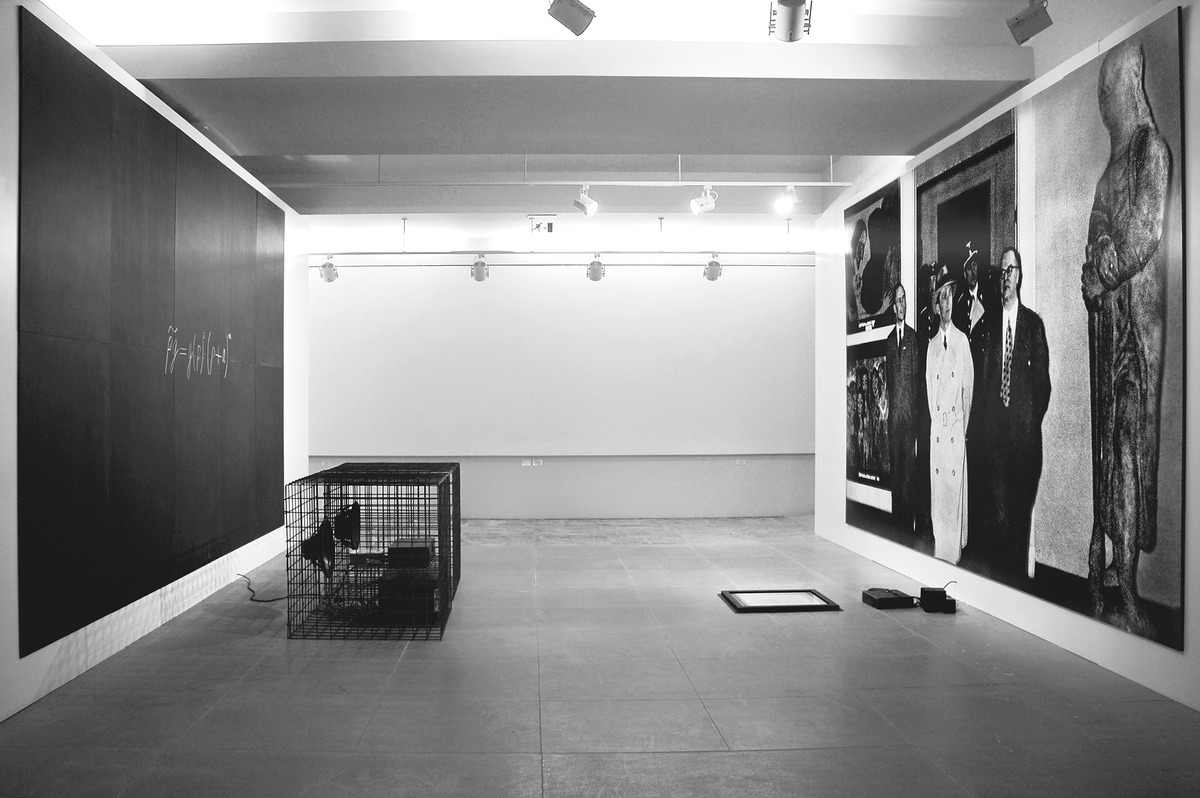


COMPONENTS: Blackboard with chalk inscription, photographic print, metal cages, framed lithograph by Giorgio de Chirico, suitcase, sound system
DIMENSIONS: Variable
Photograph: 300 × 500 cm
Blackboard: 300 × 500 cm (10 pieces: 100 × 150 cm each)
2 cages: 100 × 100 × 100 cm each
1 cage: 60 × 60 × 30cm
Suitcase: 28 × 27 × 8 cm
Lithograph: 53 × 42 cm
SOUND: What is nature?; Earthquake
PROVENANCE: Fabio Mauri Estate, Rome
COLLECTION: Castello di Rivoli Museo d’Arte Contemporanea, Rivoli-Turin
CATALOGUE: I_1978_777
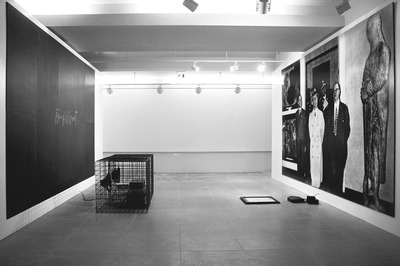
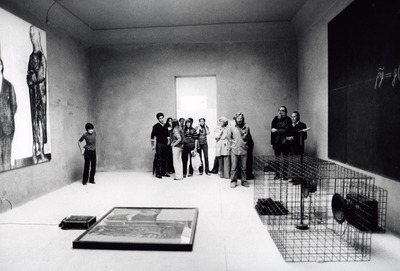
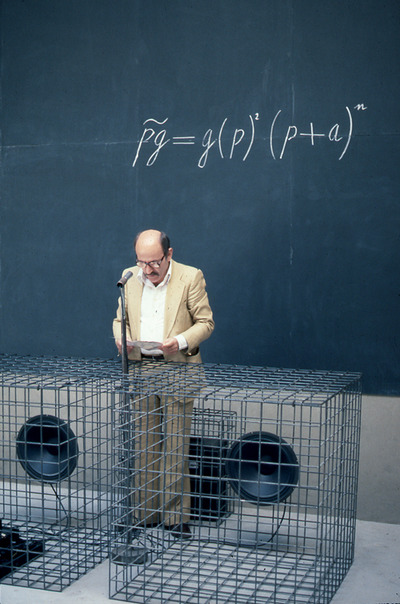
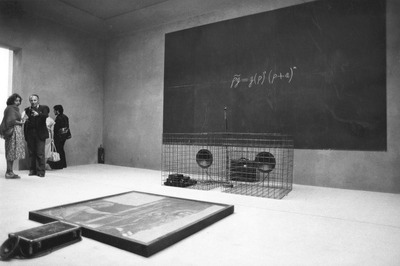
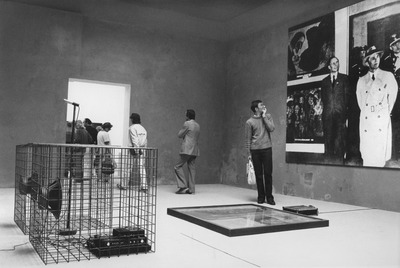
Hung on two parallel walls, a giant picture of Minister Joseph Goebbels (1897–1945) visiting the Entartete Kunst (Degenerate Art) exhibition (Berlin, 1938) and a blackboard of the same size bearing an enigmatic formula: ‘pg = g(p)2 (p+a)’ face one another. Under the blackboard, resting on the floor, three cages contained a stereo system emitting a very low, earthquake-like frequency at irregular intervals. Beneath the Goebbels photograph, a black briefcase appears to contain a clockwork device whose eerie ticking can be heard, interrupted at intervals by the question: ‘Cosa è la natura?’ (What is nature?) in several languages. Next to the suitcase, on the ground a Giorgio de Chirico lithograph depicts one of the Four Horsemen of the Apocalypse. The installation was installed in Venice for the XXXVIII Esposizione Internazionale d’Arte. Dalla natura all’arte, dall’arte alla natura, in the section curated by Lara-Vinca Masini. At the time, a fragment of Giotto’s Mystic Marriage of St Catherine of Alexandria, which had been borrowed from a Florentine antiquarian and came from the Bonacolsiana Chapel in the Torre della Gabbia in Mantua, was used instead of the de Chirico lithograph. At the event, the cages became a kind of ‘cathedra’ from which artists and critics spoke: ‘From this structure, through a microphone, contemporary thought speaks through samples.’1 Among others, Alberto Boatto, Emilio Vedova and Furio Colombo spoke. ‘The entire room becomes part of an extended history of the avant-garde, whose fate is no different from that of art, or, equally, nature. You have to return to the formula inscribed on the blackboard facing the picture, composed by the author during the course of researching the principle of intellectual error in calculation and judgment. On the possibility of calculating its incidence, envisaging it theoretically, as a useful leftover of an idea of the universe modified by a structural error: why do people make errors in judgment? What is the nature of intellectual error? In the ways and according to the customs of art, the room is presented as symbolic of a complete unfolding elsewhere, in nature as it happens. A fragment of thought neither synthetic nor simple, but complex as, it is believed, the structure of the universe is. It claims to possess the ‘whole’ fragmentary nature of every expression of art. Nature, art, ideology, criticism are presented here as poles within the same design, involved in a single law […] Understanding the formula would facilitate placement of the world and mind into a new combination. But, as has been said, according to the prerogative of art, the rule is not revealed; it is sealed within properly symbolic form.’2
1. F. Mauri, ‘Saggio senza parole’, in Topologia e morfogenesi, edited by Lara-Vinca Masini (Venice: Edizioni La Biennale di Venezia, 1978), p. 16.
2. Ibid.
1978, Venice, Giardini di Castello, XXXVIII Esposizione Internazionale d’Arte – Dalla natura all’arte, dall’arte alla natura, 2 July – 15 October, curated by Luigi Carluccio, Enrico Crispolti, Lara-Vinca Masini.
1994, Rome, Galleria Nazionale d’Arte Moderna e Contemporanea, Fabio Mauri. Opere e Azioni 1954-1994, 21 June – 5 October, curated by Carolyn Christov-Bakargiev, Marcella Cossu.
2010-2011, Trieste, Castello di Miramare, Fabio Mauri: Un sognatore della ragione, 3 December 2010 – 27 February 2011, curated by Roberto Alberton.
2012, Milan, Palazzo Reale, Fabio Mauri – The End, 19 June – 23 September, curated by Francesca Alfano Miglietti.
2015, Venice, Giardini di Castello, Central Pavilion, 56. Esposizione Internazionale d’Arte – All the World’s Futures, 9 May – 22 November, curated by Okwui Enwezor.
2020, Rivoli (Turin), Castello di Rivoli Museo d’Arte Contemporanea, Espressioni, 23 October – 15 July, curated by Carolyn Christov-Bakargiev, Marcella Beccaria, Marianna Vecellio, Fabio Cafagna.
2022-2023, Würzburg, Museum im Kulturspeicher, Die Errettung des Bösen Mögliche und unmögliche Bild, 25 November 2022 – 19 March 2023, curated by Michael Müller.
2023-2024, Rivoli (Turin), Castello di Rivoli Museo d’Arte Contemporanea, Fabio Mauri. Experiments in the Existence of Evil, 16 December 2023 – 24 March 2024, curated by Carolyn Christov-Bakargiev, Sara Codutti, Marianna Vecellio.
2025-2026, Milan, Triennale Milano, Fabio Mauri. De Oppressione, 3 December 2025 – 15 February 2026, curated by Ilaria Bernardi.
Topologia e morfogenesi. Utopia e crisi dell’antinatura. Momenti delle intenzioni architettoniche in Italia, edited by Lara-Vinca Masini (Venice: Edizioni La Biennale di Venezia, 1978), p. 9 (ill.).
Lorenzo Capellini, Alberto Moravia, Carlo Ripa di Meana, 1974-1978 Cronache della nuova Biennale (Milan: Electa, 1978), p. 133 (ill.).
La Biennale di Venezia 1978. Dalla natura all’arte, dall’arte alla natura. Settore arti visive e architettura. Catalogo generale, exhibition catalogue, La Biennale, Venice (Milan: Electa, 1978), nn. 37–39, p. 148 (ill.).
Art in America, v. 66, no. 5, New York, September–October 1978, p. 38.
L’opera dei Celebranti, exhibition catalogue, Galleria d’Arte Moderna, Ancona, edited by Marilena Pasquali (Ancona: Galleria d’Arte Moderna, 1979), pp. 52–54 (ill.).
Cesare Milanese, “La categoria dell'errore”, in Auttrib 17139, Year II, no. 3, Rome, March 1979, cover (ill.).
Arte e Critica 1980, exhibition catalogue, Galleria Nazionale d’Arte Moderna e Contemporanea, Rome, edited by Ida Panicelli (Rome: De Luca editore, 1980), p. 114 (ill.).
Fabio Mauri, “Azione. Teoria e illustrazione”, in La tradizione del nuovo, year 4, no. 13, Pinacoteca comunale, exhibition catalogue, Multigrafie, Loggetta Lombardesca, Ravenna, 1980, p. 17 (ill.).
Lara-Vinca Masini, Arte contemporanea. La linea dell’unicità: Arte come volontà e non rappresentazione (Florence: Giunti, 1989), p. 1068 (ill.).
Premio città di Avezzano XXV edizione 1989-1990, exhibition catalogue, Pinacoteca Comunale, Avezzano, edited by Mariano Apa (Urbino: Quattroventi, 1990), p. 143 (ill.).
“Retrospettiva di Fabio Mauri”, in Flash Art, Year XXVII, no. 186, Giancarlo Politi Editore, Milan, Summer 1994, p. 33 (ill.).
Fabio Mauri. Opere e Azioni 1954-1994, exhibition catalogue, Galleria Nazionale d’Arte Moderna e Contemporanea, Rome, edited by Carolyn Christov-Bakargiev, Marcella Cossu (Milan / Rome: Editoriale Giorgio Mondadori / Carte Segrete, 1994), pp. 182–185 (ill.).
Città Natura: Mostra internazionale di arte contemporanea, exhibition catalogue, Villa Mazzanti and Palazzo delle Esposizioni, Rome (Rome: Fratelli Palombi Editori, 1997), pp. 18, 226–228 (ill.).
L’ospite armeno, exhibition catalogue, Giardini di Palazzo Zenobio and Loggia del Temanza, Venice, edited by Corrado Bologna, Silvia Bre, Riccardo Giagni, Gianfranco Salvatore (Venice: Oemme Edizioni, 2001), pp. 52–53 (ill.).
Lara-Vinca Masini, L’Arte del Novecento n.6: Dall’Espressionismo al Multimediale (Rome: Gruppo editoriale L’Espresso, 2003), p. 1068 (ill.).
Ludovico Pratesi, “L'uomo che proiettò Gesù sul corpo di Pasolini”, in Il Venerdì, no. 780, Rome, 28 February 2003, p. 99 (ill.).
Adachiara Zevi, “L'arte ‘saggistica’ di Fabio Mauri”, in L’architettura – cronache e storia, no. 575, Rome, 2003, p. 670 (ill.).
Fabio Mauri, Scritti in mostra. L’avanguardia come zona 1958-2008, edited by Francesca Alfano Miglietti (Milan: il Saggiatore, 2008), pp. 56–59 (ill.).
Fabio Mauri, Io sono un ariano (Milan: Lampi di stampa, 2009), pp. 191–198 (ill.).
Fabio Mauri. Un sognatore della ragione, exhibition catalogue, Castello di Miramare, Trieste, edited by Federica Alberton (Cinisello Balsamo: Silvana Editoriale, 2010), pp. 31–33 (ill.).
Elena Volpato, “Fabio Mauri: starting from the end”, in Mousse, no. 29, Milan, Summer 2011, pp. 148 (ill.), 150.
Fabio Mauri. The End, exhibition catalogue, Palazzo Reale, Milan, edited by Francesca Alfano Miglietti (Milan: Skira, 2012), pp. 77–84 (ill.).
Silvano Manganaro, “La storia tra furia e memoria”, in Il Giornale dell'Arte – Vernissage, Year XXX, no. 321, Turin, June 2012, p. 7 (ill.).
Federica Boràgina, Fabio Mauri. Che cosa è, se è, l’ideologia nell’arte (Catanzaro: Rubbettino editore, 2012), pp. 71–72, no. 14, p. 72 (ill.).
Elisabetta Catalano, Work with Fabio Mauri, edited by Laura Cherubini (Milan: Maretti Editore, 2013), pp. 66–67 (ill.).
Fabio Mauri, exhibition catalogue, Fundación PROA, Buenos Aires, edited by Giacinto Di Pietrantonio (Buenos Aires, 2014), pp. 70–71 (ill.).
56. Esposizione Internazionale d’Arte: All the World’s Futures: Mostra, exhibition catalogue, La Biennale, Venice, edited by Okwui Enzewor (Venice: Fondazione La Biennale di Venezia / Marsilio, 2015), pp. 138–139 (ill.), 615.
Riccardo Venturi, “Fabio Mauri: cinema a luce solida”, in Flash Art, Year 49, no. 321, Milan, 2015, p. 47 (ill.).
Valérie Da Costa, Fabio Mauri: le passé en actes (Dijon: Les presses du réel, 2018), no. 86, p. 153 (ill.).
Mauri, edited by Flaminio Gualdoni (Milan: Corriere della Sera, 2022), pp. 24, 52–55, 86–87 (ill.).
Castello di Rivoli Museo d'Arte Contemporanea. La storia e le collezioni, edited by Carolyn Christov-Bakargiev, Marcella Beccaria (Turin: Società editrice Umberto Allemandi, 2023), pp. 704–705 (ill.).
Marcella Vanzo, “Nel buio del mondo”, in Artedossier, no. 437, Florence, December 2025, p. 28 (ill.).