

COMPONENTS: 18 screen-printed canvases, two objects in wood and screen-printed canvas, light
DIMENSIONS: Room: 500 × 400 × 300 cm
17 canvases: 300 × 100 cm each
1 canvas: 88 × 100 cm
1 object: 52 × 40 × 33 cm
1 object: 72 × 102 × 42 cm
PROVENANCE: The artist
COLLECTION: Fabio Mauri Estate, Rome
CATALOGUE: I_1970_3427
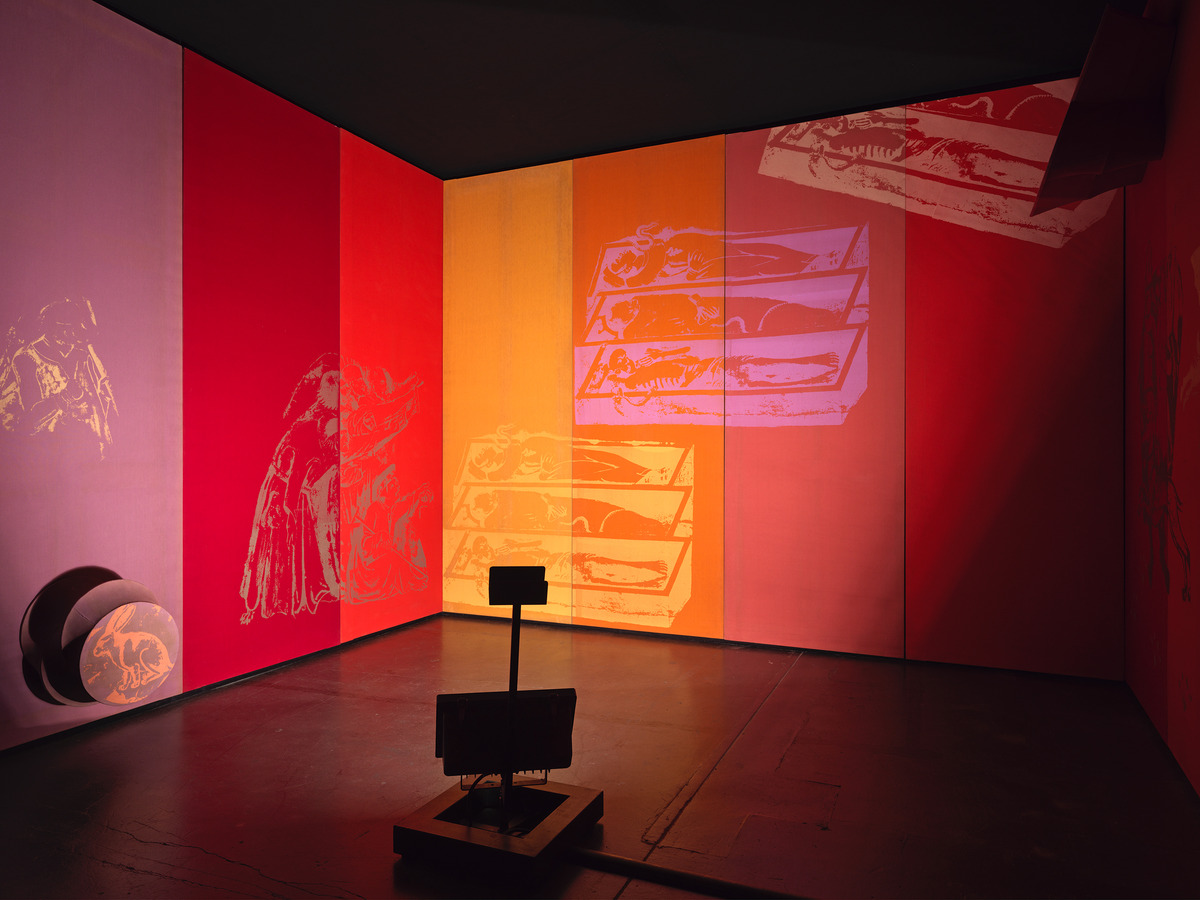
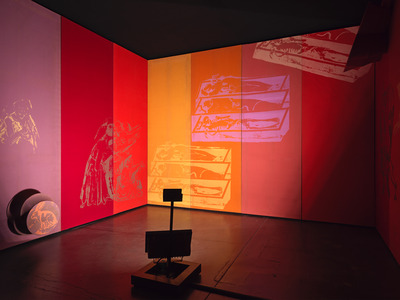
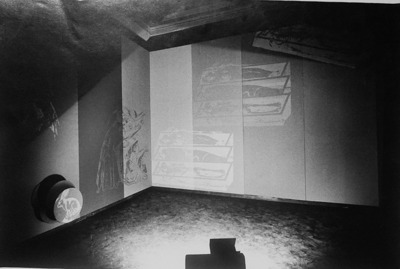
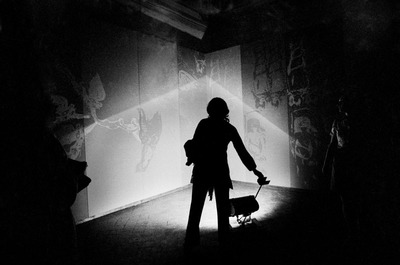
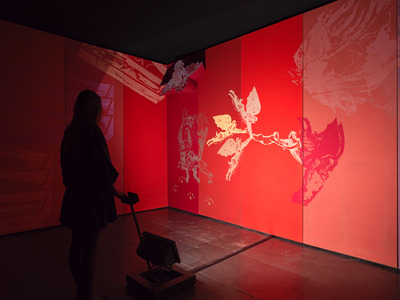
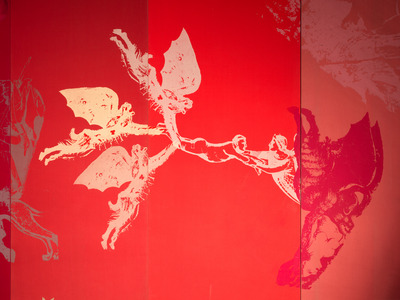
An installation created for the ‘Amore mio’ exhibition at Palazzo Ricci in Montepulciano, which opened on 30 June 1970. Overturning customary organisational practice, sixteen artists ‘self-convened’ through a series of consultations, called on Achille Bonito Oliva to ‘contradict the role of art critic’.1 The artists involved were Carlo Alfano, Getulio Alviani, Mario Ceroli, Gianni Colombo, Gabriele De Vecchi, Luciano Fabro, Jannis Kounellis, Renato Mambor, Gino Marotta, Fabio Mauri, Mario Merz, Mario Nanni, Maurizio Nannucci, Michelangelo Pistoletto, Paolo Scheggi and Cesare Tacchi; Piero Sartogo was in charge of ‘image coordination’. Each artist was given a room in the building to display ‘the matrices of their expressive position’.2 Mauri covered the walls of his assigned space with a series of canvases reprising scenes and details from the Trionfo della morte (Triumph of Death), a fourteenth-century fresco in Pisa’s Camposanto attributed to Andrea di Cione di Arcangelo, known as Orcagna.3 He selected, decontextualised and reproduced damned souls, symbolic figures, devils and skeletons in brightly coloured silkscreens on coloured canvases. Above them, two elements from the same canvas, shaped and turned inside out, show a rabbit and an angel-Lucifer projecting toward the room’s interior. The audience was able to direct a revolving spotlight attached to the floor in the centre at will to cast light on details in the otherwise dark room. Through the contrast between medieval iconography and modern graphic rendering, Mauri identified an ‘expressive stance’ between historical roots and new stylistic approaches, adopting a modus operandi that, elsewhere, the artist would refer to as ‘a present-day use of the past’.4
1. See A. Bonito Oliva, ‘Autocritico automobile’, in Il Formichiere, Foligno, 1977, pp. 157–58.
2. Ibid.
3. The fresco is now attributed by scholars almost unanimously to Buonamico di Martino, known as Buffalmacco.
4. F. Mauri, ‘Note su “zeichen-ung” (Warum ein Gedanke einen Raum verpestet?)’, in Proposta, no. 2–3, Benevento, 1972, p. 36.
1970, Montepulciano (Siena), Palazzo Ricci, Amore mio, 30 June – 30 September, curated by Achille Bonito Oliva.
2023, Zurich, Hauser & Wirth, Fabio Mauri. Amore mio, 30 September – 23 December, curated by Olivier Renaud-Clément.
2025-2026, Milan, Triennale Milano, Fabio Mauri. De Oppressione, 3 December 2025 – 15 February 2026, curated by Ilaria Bernardi.
G. C., “Mostre - Un palazzo antico per l'avanguardia”, in L’Espresso, no. 31, Milan, 2 August 1970, pp. 24–25 (ill.).
Silvana Sinisi, “Montepulciano: itinerari per una esperienza soggettiva”, in Marcatrè, no. 58–60, Lerici editore, Milan, 1970, p. 158.
“Amore mio. La mostra di Montepulciano”, in Bolaffi Arte, Year I, no. 3, Turin, October 1970, pp. 50–51 (ill.).
Filiberto Menna, “Gli artisti si sono autoconvocati per confessare il loro amore segreto”, in Il Mattino, Naples, 6 August 1970, .
Domus, no. 490, Milan, 1970, p. 47.
Amore mio, exhibition catalogue, Palazzo Ricci, Montepulciano (Siena), edited by Achille Bonito Oliva (Florence: Centro Di Edizioni, 1970), n.p.
Achille Bonito Oliva, Autocritico automobile. Attraverso le avanguardie (Milan: Il Formichiere, 1977), pp. 157–162.
Studi di Memofonte, no. 9, 2012 (www.memofonte.it), pp. 121–151 (ill.).
Tra / Between arte e architettura, exhibition catalogue, MAXXI Museo nazionale delle arti del XXI secolo, Rome, edited by Achille Bonito Oliva (Turin: Allemandi & C., 2014), pp. 99–111.
Delta ti: In tempo reale, exhibition catalogue, Museo Carlo Bilotti, Rome (Rome: Nero, 2015), p. 85 (ill.).
A.B.O. Theatron: L’arte o la vita, exhibition catalogue, Castello di Rivoli Museo d’Arte Contemporanea, Rivoli, edited by Achille Bonito Oliva, Carolyn Christov-Bakargiev (Milan: Skira, 2021), pp. 40, 180–189 (ill.).
Marcella Vanzo, “Fabio Mauri, o la profezia dello schermo”, in ArtsLife, 21 October 2023 (https://artslife.com/2023/10/21/fabio-mauri-o-la-profezia-dello-schermo/), n.p. (ill.).
Marcella Vanzo, “Nel buio del mondo”, in Artedossier, no. 437, Florence, December 2025, pp. 26–27 (ill.), 30.